

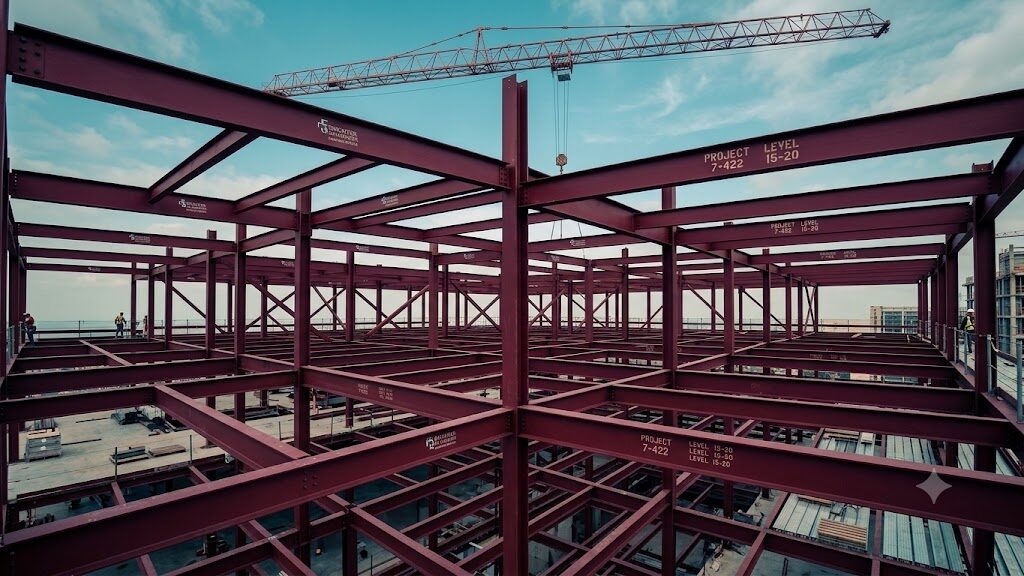
Complex connections are where takeoff time concentrates. A standard shear connection is a fast count. A seismic moment connection, a heavy braced-frame gusset, or a transfer girder connection takes far more work. It brings continuity plates, doubler plates, stiffeners, haunches, and weld callouts across multiple details. It also needs load verification that a standard detail cannot be assumed to cover. The component density is an order of magnitude higher. The details are scattered across more sheets, and the cost of a miss is proportionally larger.
Most estimating guidance treats connections as a single category. In practice, the small population of complex connections on a project consumes a disproportionate share of takeoff hours. It also produces a disproportionate share of the errors that reach fabrication. Handling them efficiently is a distinct skill with a distinct workflow.
This article covers that workflow: how to isolate complex connections, work through them with a component checklist, reuse validated templates, and verify against AISC design references. It also covers where AI takeoff tools speed up the process and where estimator judgment cannot be delegated.
This article sits under Building a High-Performance Steel Estimating Workflow. It is the complexity-focused companion to two other articles. Connection Identification: A Systematic Approach covers the categorization framework. Connection Takeoff: Where Most Errors Occur and How to Fix Them covers the recurring error patterns.
Why Complex Connections Consume So Much Takeoff Time
Four characteristics separate complex connections from the standard population.
Component density. A moment connection carries far more individual parts than a simple shear connection. These include the connection plates themselves, continuity plates, doubler plates where the column web needs reinforcement, stiffeners, and the weld and bolt scope for each. Every component is a line item the takeoff has to capture for the labor estimate to hold.
Detail dispersion. The information needed to price one complex connection rarely lives in one place. The framing plan shows the location, and a detail sheet shows the configuration. The general notes carry the default weld specifications. The specifications book carries the inspection and finishing requirements. Missing any one of those sources produces an incomplete count.
Load verification. Standard details cannot be assumed for high-load configurations. The AISC Steel Construction Manual Parts 9 through 15 govern connection design. For seismic systems, the moment and braced-frame connections this article covers are also governed by AISC 341 (Seismic Provisions), which carries requirements standard details do not address. For HSS connections, AISC Design Guide 24 is the reference. When engineering specifies a non-standard configuration, the estimate has to reflect what the references require. The standard library’s assumptions no longer apply.
Fabrication nuance. Shop versus field classification, welding access, assembly sequence, and finishing requirements all affect labor on complex connections more than on standard ones. These are the judgment calls that get rushed when the bid deadline tightens.
The financial context is the same one that runs through all takeoff work. According to the Construction Industry Institute, rework runs from 2% to 20% of a project’s contract amount. The CFMA Construction Financial Benchmarks Report shows net profit margins in the 5-8% band. Complex connections are where a small number of misses does the most margin damage. Each miss carries more components, more labor, and more schedule exposure than a standard-connection miss.
The Four-Step Workflow for Complex Connections
Step 1: Isolate Complex Connections First
Work the complex connections as a dedicated pass, before or separate from the general member takeoff, while attention is fresh. The worst position to be in is reaching the moment frames at hour nine of a takeoff with the bid due tomorrow.
Identify the population during the initial drawing review: moment frames, braced frames, transfer conditions, heavy base plates with uplift, anything the general notes flag for special inspection. That population gets its own time budget and its own review pass.
For the intake discipline this depends on, see Steel Takeoff Checklist: What Every Estimator Should Verify.
Step 2: Work Each Connection Against a Component Checklist
Checklists matter most on complex connections, because no estimator can hold that many components in memory. For each complex connection, verify:
- Plate sizes and thicknesses, including continuity and doubler plates
- Weld types and lengths per the detail and the governing notes
- Bolt diameters, grades, and counts per the applicable ASTM specification
- Stiffeners and haunches
- Shop versus field classification, traced to an explicit drawing note
- Fireproofing or coating scope, cross-referenced against the specifications
- Special inspection requirements
The classification and coating items are the two most commonly missed, because they live in the specifications rather than on the structural sheets. For the ambiguity-handling discipline when the sources conflict, see Handling Incomplete or Ambiguous Drawings.
Step 3: Reuse Validated Connection Templates
The complex connections your shop sees repeatedly should exist as validated library entries. Each entry holds the component list, the material specs, and labor factors drawn from your shop’s actual production data. A seismic moment connection template built and validated once turns the next occurrence from a from-scratch count into a verification pass.
The naming and versioning discipline matters as much as the templates themselves. For the full framework, see Creating Reusable Templates and Assemblies for Steel Estimation.
Step 4: Cross-Check Against the AISC References
For every complex connection, verify the configuration against the AISC Manual connection parts. Flag anything exceeding standard capacities for engineering review rather than absorbing the assumption into the bid. Seismic connections get checked against the AISC 341 requirements the project specifies. HSS configurations get checked against Design Guide 24.
This step is required on complex work, and it is the first step to get cut under time pressure. Budget for it explicitly in Step 1 to protect it.
Where AI Tools Actually Help on Complex Connections
AI takeoff tools accelerate specific parts of this workflow. Knowing which parts keeps expectations realistic.
Detection of connection conditions. SketchDeck’s automated connection analysis identifies framing conditions, moment connections, copes, and holes across the drawing set, with detection accuracy on most projects landing in the 95-99% range. For the complex-connection workflow, that means the population you need to isolate in Step 1 surfaces systematically rather than depending on a page-by-page hunt. For the mechanics, see Did You Know: How SketchDeck Automates Weights, Connections, and Labor Codes.
Your shop’s labor codes applied consistently. SketchDeck applies custom labor codes to detected connection categories, so the connection scope feeds pricing without manual transfer, using your shop’s rates rather than generic assumptions.
Custom fields for the judgment calls. Shop-versus-field classification, weld designations, and coating scope can be structured as custom fields, dropdowns, and rule-based automations in the Quantities Panel. The Step 2 checklist then becomes part of the takeoff record itself instead of a separate document. For the walkthrough, see Did You Know: How to Customize Your Quantities Panel in SketchDeck.
Revision handling. When drawings revise, Revision Management marks changed members explicitly. A revision touching three moment connections becomes a focused update on those three rather than a re-verification of the whole population.
Where the estimator stays essential. Load verification against the AISC references, interpretation of ambiguous weld callouts, shop-versus-field decisions traced to drawing notes, and fabrication sequence judgment all stay with the estimator. The tools remove the detection and bookkeeping work so those calls get the time they need. For the honest boundary, see What AI Can and Cannot Do in Steel Estimating: Setting Realistic Expectations.
The most relevant customer evidence here is King Steel, whose published case study is specifically about complex structural projects: they cut estimation time roughly in half on complex work through a structured implementation. Read the King Steel case study. Vice President of Estimating Troy Ernst:
“It’d be awful not to have [SketchDeck]. We’re relying on it now.”
Maccabee Industrial documented 75% time savings on large projects; read the Maccabee case study. The engaged-review dynamic that makes the partnership work is the configuration the human-in-the-loop research literature consistently identifies as highest-performing. It matters most on the high-stakes connections this article covers.
To check whether your team is ready to systematize complex-connection work, read 5 Signs Your Steel Estimating Process Is Ready for an AI Transformation.
Best Practices That Compound
Estimate complex connections first, not last. Attention is a resource. Spend it where the component density is highest.
Save every unique complex connection as a template. The first time is a count. Every time after is a verification. The library compounds across projects.
Validate with the fabrication team. Shop foremen see assembly and access issues in connection configurations that estimators reading drawings do not. A pre-bid review of the complex-connection population with the shop is one of the most valuable hours in the workflow.
Track variances after every project. Where complex-connection actuals diverge from the estimate, feed the finding back into the template. For the full feedback-loop discipline, see Reconciling Your Takeoff with Fabrication Reality.
Never assume standard loads. If the configuration is unusual or the loads are high, verify against the references or flag for engineering review. The assumption you absorb silently is the one that surfaces in fabrication.
The Bottom Line
Complex connections are unavoidable. Treating them as a distinct workflow category is what keeps them from consuming the takeoff. Isolate the population early, work each connection against a component checklist, and reuse validated templates. Verify against the AISC references rather than assuming standard details cover high-load work.
AI tools surface the connection population systematically, apply your shop’s labor codes consistently, and turn revisions into focused updates. The load verification, classification judgment, and sequence reasoning stay with the estimator. That is where the freed hours should go.
To see how the workflow runs on your own complex projects, run an upcoming bid through SketchDeck in parallel with your current process. Then compare where the hours go. You can start by booking a live demo.
Related reading
- Building a High-Performance Steel Estimating Workflow
- Connection Identification: A Systematic Approach
- Connection Takeoff: Where Most Errors Occur and How to Fix Them
- Creating Reusable Templates and Assemblies for Steel Estimation
- Reconciling Your Takeoff with Fabrication Reality
- Handling Incomplete or Ambiguous Drawings