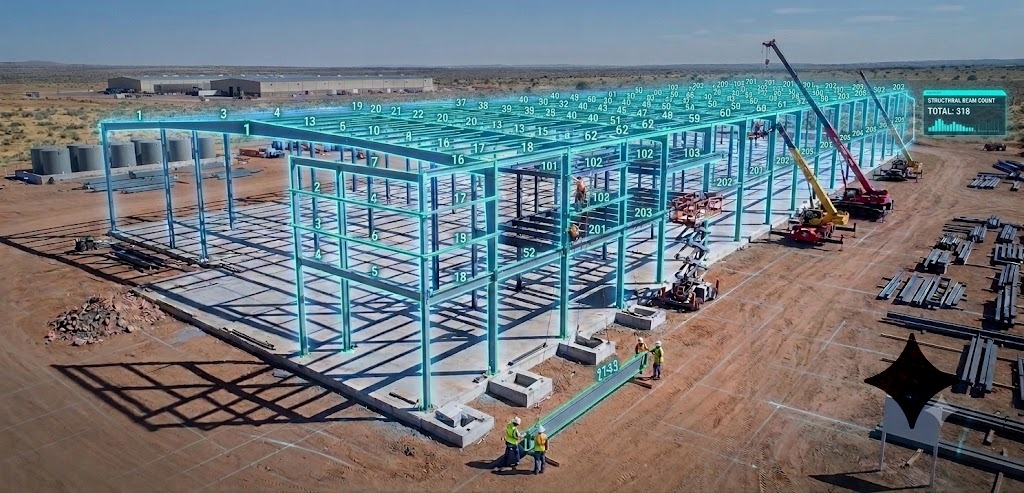


The short answer is no. The longer answer is that AI will not replace estimators, but estimators who refuse to use AI will lose ground to those who do, because AI multiplies their capacity. The research is consistent on this. The customer data is consistent on this. The question is not whether to adopt AI but how to use it as an augmentation tool rather than treating it as a replacement system.
This article sits under The Ultimate Guide to Steel Estimating and walks through what the research actually says, what AI can and cannot do in estimating, and what three SketchDeck customers documented when they put the augmentation model into practice.
What the Research Says About AI Replacing Knowledge Workers
The “AI will replace knowledge workers” framing is loud, but the empirical research tells a more specific story: AI is a partner that augments work, not a wholesale replacement, especially for roles that require judgment and domain expertise.
Two reference points from the academic side:
A 2025 Stanford study from Erik Brynjolfsson’s team at the Stanford Digital Economy Lab, based on analysis of millions of payroll records, found a clear pattern: when AI use is automative (replacing the worker’s task entirely), entry-level employment in those occupations declines. But when AI use is augmentative (supporting the worker’s judgment), employment in those occupations actually grows. The study’s authors frame it directly: “Not all uses of AI are associated with declines in employment. In particular, entry-level employment has declined in applications of AI that automate work, but not those that most augment it.”
The implication for estimating is specific. The question is not whether AI will be involved (it will), but whether it is deployed in an augmentation pattern (estimator owns the work, AI does the volume tasks) or an automation pattern (the tool tries to replace the estimator). The first pattern is the one customers report.
On the industry side, McKinsey Global Institute’s research on generative AI and the future of work concludes that generative AI is “enhancing the way STEM, creative, and business and legal professionals work rather than eliminating a significant number of jobs outright.” Construction specifically is short approximately 400,000 workers, which means the labor pressure is in the opposite direction of replacement. More recent McKinsey research from November 2025 finds construction has “low technical automability” because over 80% of construction work involves physical tasks AI agents cannot replicate. The same report shows demand for AI fluency in job postings grew 7x between 2023 and 2025, going from about 1 million workers in AI-fluent roles to about 7 million.
The estimators who learn to use AI tools are the ones whose roles expand. The estimators who do not are the ones who get out-bid by shops that did.
Why AI Feels Like a Threat (and Why It Isn’t)
The fear that AI will replace estimators is understandable. New tools can scan drawings, detect symbols, and suggest quantities in minutes, which can look like a digital estimator from the outside. Add the constant time pressure most estimators are under, and anything promising “instant takeoffs” sounds like it could make the role redundant.
But when you look closer, current AI tools do not do what estimators actually own. They do not understand construction intent, local means and methods, or field reality. They do not interpret vague notes, missing details, or conflicts between drawings. They do not talk to GCs, negotiate scope, or explain assumptions to owners. They count well. They do not understand.
That distinction is the core of the capacity multiplication argument: let AI handle counting at scale and let estimators handle understanding. For more on what AI actually does (and does not do) on a drawing, see What AI Can and Cannot Do in Steel Estimating: Setting Realistic Expectations and The Precision Gap: Why “Automated” Takeoff Software Is Failing Steel Estimators.
What AI Can and Cannot Do in Estimating
AI is strong at speed and consistency, weak at context and judgment.
Good at:
- Detecting elements on drawings (beams, columns, walls, slabs) much faster than humans.
- Reading labels and schedules to pull sizes, lengths, and quantities automatically.
- Applying the same rules across hundreds of sheets without getting tired or distracted.
Not good at:
- Interpreting scope notes that change what is included vs excluded.
- Understanding sequencing, productivity, or constructability in real field conditions.
- Deciding which alternates to carry, where risk sits, or how aggressive to price.
A systematic review of human-in-the-loop AI published in MDPI Entropy finds that hybrid models combining AI processing with human oversight consistently outperform both fully automated approaches and human-only operators in high-stakes domains. The same configuration applies to estimating. AI does the volume work, estimators handle the judgment, the combination beats either alone.
For more on what AI actually sees on a drawing, see How AI Reads Structural Steel Drawings and Computer Vision in Construction.
The Capacity Multiplication Argument
The real story is not “AI vs estimators.” It is “estimators with AI vs estimators without AI.”
Capacity multiplication means three things:
- The same team can handle 2-3x more bids because AI removes the slowest tasks.
- Estimators spend more of their time on decisions and less on measuring, clicking, and typing.
- Firms using AI get faster, more consistent bids to market while competitors hit a hard ceiling on output.
The structural backdrop makes this urgent. Construction Dive’s analysis of the estimator talent gap cites AGC data showing one in four construction workers is over 55, with 41% projected to retire by 2031. The BLS Occupational Outlook Handbook projects cost estimator employment to decline 4% from 2024 to 2034, with software cited as a primary productivity driver. You cannot hire your way out of the bottleneck. The estimators you need are aging out faster than they are being replaced.
For the deeper case on the labor gap, see The Steel Estimating Crunch: Labor, Capacity, and Competitive Pressure Explained and The Great Capacity Paradox: Why Steel Fabricators and Erectors Are Leaving Money on the Table.
How SketchDeck Multiplies Capacity (Without Replacing Anyone)
SketchDeck is built around the partnership model that the research consistently identifies as the highest-performing configuration.
What SketchDeck’s AI does:
- Reads PDF structural drawings, including large multi-hundred-page sets.
- Automatically detects beams, columns, braces, joists, and other structural members.
- Extracts attributes (size, length, camber, studs, piece marks) and calculates weights and tonnage.
- Analyzes connection context (copes, holes, framing conditions, moment frames).
- Generates structured BOMs and exports them into Tekla PowerFab, Excel, and other existing tools.
For more on how the system handles weights and connections, see Did You Know: How SketchDeck Automates Weights, Connections, and Labor Codes.
What estimators still own:
- Scope decisions, alternates, inclusions, and exclusions.
- Reviewing AI output, correcting oddities, and focusing on complex or risky areas.
- Pricing, contingency, negotiation, and bid strategy.
The division of labor matches what Stanford’s research describes as the augmentative pattern: the estimator owns the work, AI handles the volume tasks. That is the configuration where employment grows, not shrinks.
For more on how the underlying system improves over time, see Machine Learning in Construction: How SketchDeck Gets Smarter Over Time.
Real Evidence: Capacity Multiplication With SketchDeck
The capacity multiplication argument becomes concrete when you look at what steel shops are actually doing with SketchDeck. Three named customers, three documented patterns.
MotionSteel: From 30-40 to 70 Estimates Per Month
MotionSteel’s case study documents the team going from 30-40 estimates per month to about 70 after adopting SketchDeck, more than doubling bid volume with the same core team. Their General Manager Jay Livesey put it directly:
“It was a no brainer. I’ve been estimating for probably 8 years using just the good ol’ highlighter and paper, wishing for a program that could automate this process. [SketchDeck] frees up more time for your employees to do a better job and better review. With [SketchDeck], we went from doing roughly 30 to 40 estimates a month to hitting 70 monthly.”
Notice the framing: SketchDeck frees up time for employees to do a better job. Not “replaces employees.” Read the full MotionSteel case study.
MSE: 95% Reduction on Beam Takeoffs, One Week Per Month Reclaimed
MSE achieved up to 95% reduction in time spent on beam takeoffs for larger projects, freeing roughly one work week per estimator per month. They used that extra capacity to bid more work and focus more on pricing and coordination, not to cut staff. Overall accuracy on AI takeoffs in the 95-99% range allows MSE to use the output as a trusted baseline rather than a starting point that needs full re-verification. Read how MSE reduced their time spent on beam takeoffs by 95%.
Maccabee Industries: 75% Faster on Large Jobs, 50% Overall
Maccabee Industrial saw 75% faster takeoffs on large projects and about 50% overall speed improvement across their estimating workflow. They used SketchDeck to pursue more and larger projects as their fabrication capacity grew. Dawn Hargraves, one of their estimators, captured the augmentation reality clearly:
“I actually appreciate that it’s not 100% perfect because it keeps me engaged and checking the work. We can catch any issues while still saving massive amounts of time.”
That is exactly the partnership model. The AI does the volume work, the estimator stays in the loop, and the combination outperforms either alone. Read the full Maccabee case study.
In every case, the value came from multiplying what estimators could do, not replacing them. For the broader case, see How AI Multiplies Estimator Capacity (With Real Examples) and Breaking the Headcount Barrier: Scaling Bids Without Hiring.
Wondering whether your team is ready? 5 Signs Your Steel Estimating Process Is Ready for an AI Transformation is a quick readiness check before you start a pilot.
How the Role of Estimator Is Changing
AI is changing what a “good estimator” looks like, but in a way that increases the value of their judgment, not the other way around.
New emphasis:
- Less manual tracing and more oversight of AI-generated quantities.
- Less data entry and more time on risk, constructability, and client conversations.
- New skills around reading AI outputs, asking the right questions, and using structured data to make better decisions.
McKinsey’s data backs the skills shift. The November 2025 MGI report shows demand for AI fluency in job postings grew 7x in two years. The estimators who develop that fluency become more valuable, not less.
For more on how AI tools integrate with existing workflows without disrupting them, see How AI Integration Transforms Existing Steel Estimating Workflows Without Disrupting Your Team. For the change management side, see Change Management for AI in Steel Estimating: How to Bring Your Team Along.
What This Means for Steel Estimators Today
For steel estimators, the real risk is not that AI will replace the job. It is that shops that adopt AI will outbid those that do not.
Practical takeaways:
- AI will keep getting better at reading drawings and counting, but it will still need human estimators to interpret scope and manage risk.
- SketchDeck and similar tools let one estimator do the work of two or three by removing manual bottlenecks, as MotionSteel, MSE, and Maccabee have documented.
- Estimators who embrace AI become more valuable. They control more revenue, handle bigger workloads, and play a larger strategic role in the business.
The Stanford research is clear about the pattern: in occupations where AI is used augmentatively, employment grows. In occupations where AI replaces work entirely, employment shrinks. Estimating sits firmly in the first category as long as estimators stay in the loop, which is the configuration SketchDeck is built around.
So the answer to “Will AI replace estimators?” is no. But it will replace slow processes. Estimators who use AI tools like SketchDeck to multiply their capacity will be the ones leading their shops through the next decade.
The first step is simple. Run an upcoming bid through SketchDeck in parallel with your current process, compare time and accuracy against your baseline, and decide where AI multiplies your team’s capacity most. You can start by booking a live demo.
Related reading
- The Ultimate Guide to Steel Estimating: Best Practices for Fabrication Success
- What AI Can and Cannot Do in Steel Estimating: Setting Realistic Expectations
- How AI Multiplies Estimator Capacity (With Real Examples)
- Breaking the Headcount Barrier: Scaling Bids Without Hiring
- The Steel Estimating Crunch: Labor, Capacity, and Competitive Pressure Explained