

How Human Estimators Read Drawings
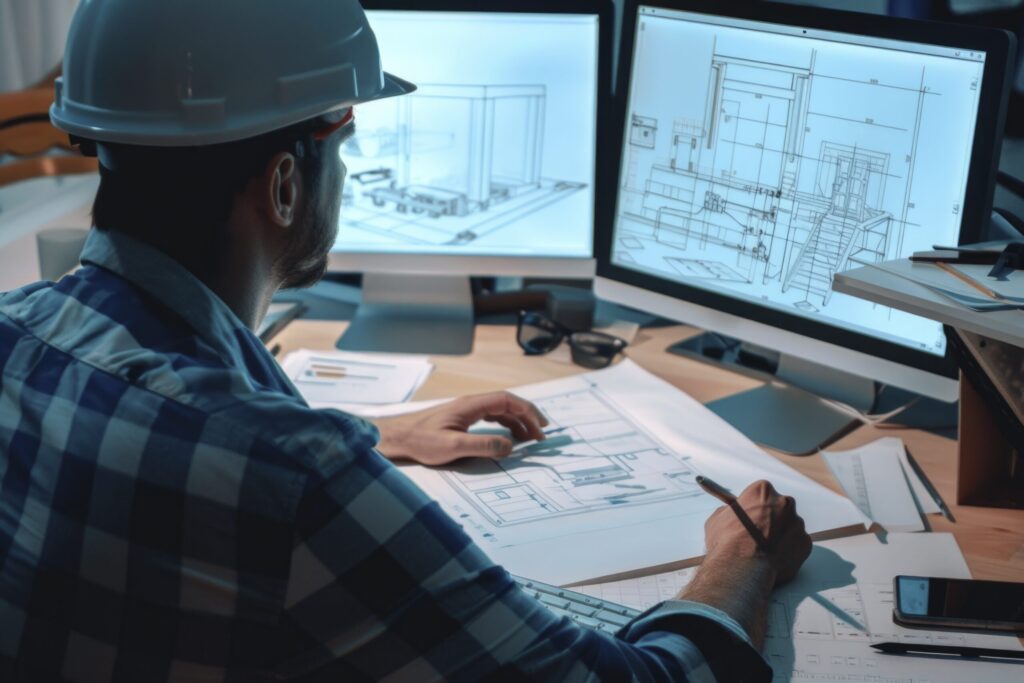
When an experienced estimator opens a structural set, they are not just reading lines; they are reconstructing a 3D structure, load paths, and risk profile in their head.
- Estimators quickly lock onto high‑value regions such as connections, irregular framing, and load transfer points, rather than scanning every square inch at the same level of detail.
- Years of experience turn drawing conventions into instant signals: dashed lines for hidden members, hatch patterns for materials, weld symbols for labor, and dimension strings that define geometry and piece sizes.
This mental model lets human estimators handle vague notes, contradictory dimensions, or incomplete details and still understand the intent of the design. The trade‑off is fatigue: after hours of counting repetitive beams on a big‑box roof plan, attention drops and mistakes slip in.
For a full walkthrough of how this human process fits into the end-to-end estimating workflow from scope review to final price, see The Ultimate Guide to Steel Estimating: Best Practices for Fabrication Success on the SketchDeck.ai blog.
How AI Sees Your Structural Steel Drawings
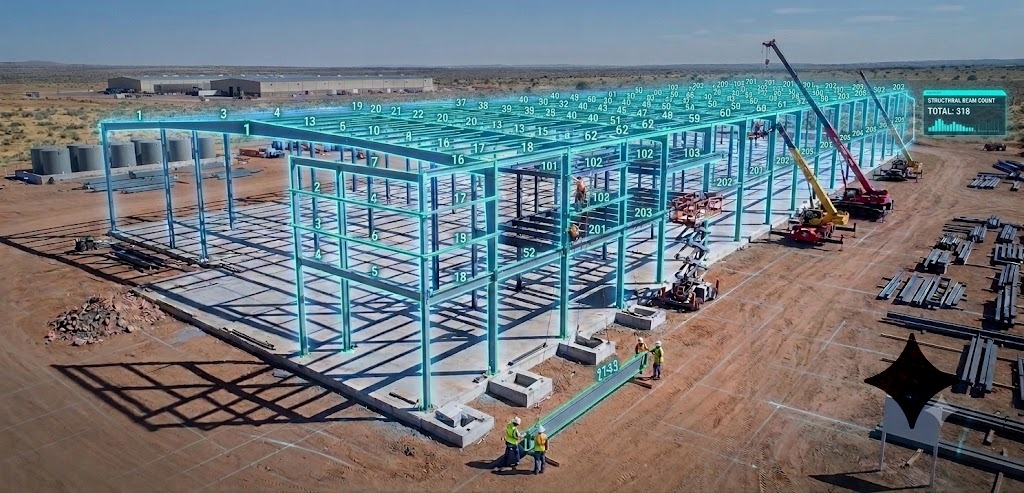
AI takeoff tools like SketchDeck do not see beams and columns first; they see pixel grids and patterns that are converted into objects through computer vision models.
- A typical 24×36 inch sheet scanned at 300 dpi is about 7,200 × 10,800 pixels, or roughly 78 million data points per page.
- Each pixel is represented numerically (for example, 0–255 per channel in 8-bit images), and convolutional neural networks (CNNs) learn to detect edges, shapes, annotations, and symbols across that grid. Stanford’s CS231n notes on CNNs offer a good introductory explainer.
CNNs process the image in stages: early layers pick up edges and corners, deeper layers combine these into shapes such as rectangles, angle profiles, or bolt clusters, and higher layers learn to associate these shapes with labeled objects like beams, columns, braces, or callouts.
- Object‑detection architectures divide the drawing into regions and assign a confidence score to each detected object, such as “beam, 0.97” or “handwritten note, 0.40.” A high‑level overview of this pattern is in Ujjwal Karn’s “An Intuitive Explanation of Convolutional Neural Networks” (https://ujjwalkarn.me/2016/08/11/intuitive-explanation-convnets/).
- SketchDeck is trained on large volumes of structural steel drawings, which allows it to detect main structural members on most clean digital plans with roughly 95–99% accuracy.
Importantly, the model recognizes patterns but does not understand intent or constructability the way a human does. It can correctly tag a member as W18×40 with high confidence without “knowing” whether that member is part of a moment frame or whether the connection is buildable.
For a broader perspective on computer vision applied to construction drawings and quantity takeoff, see:
- Purdue’s paper on computer-vision-based quantity takeoff from 2D PDFs (time reduction of ~99% on irregular area QTO with ~94% accuracy)
- Jamieson et al.’s paper AI-powered symbol detection: towards fully automated interpretation of construction drawings.
Where AI Outperforms Manual Takeoff
When you map AI’s strengths onto the estimating workflow, they line up almost exactly with the tasks human estimators find tedious and error‑prone.
-
Speed on repetitive counting: On typical clean PDFs, AI takeoff tools can cut the initial counting phase from many hours to minutes, especially for framing plans with regular grids and repeated conditions.
- Cortex DM describes computer-vision analysis of construction drawings reducing takeoff time by around 80% in some workflows
- Autodesk reports quantity takeoff time reductions of more than 50% when automating parts of the process.
-
Consistency across pages: Models apply the same detection logic to every page, so the 49th sheet is treated with the same attention as the first, without “Friday afternoon” drift.
-
Coverage in congested areas: In dense framing zones or overlapped linework, AI systems systematically scan all pixels and often flag members that humans miss when they are visually overloaded.
In SketchDeck.ai’s customer base, fabricators report that what used to take an estimator days to count now takes minutes, which frees that time for connection strategy, pricing, and value engineering. SketchDeck quantifies main members in minutes, not hours, and is already helping teams reduce estimating time by up to 80%, with more than $25 billion in bids processed through the platform.
For a category-level overview of how AI is changing construction estimating, see the Autodesk Construction Blog on AI and automation in estimating and the Programming Historian’s tutorial on CNNs for image classification, which gives more background on the models behind computer vision.
Where Human Estimators Are Still Essential
Even as AI gets better at reading drawings, human estimators remain critical for interpreting intent, resolving ambiguity, and making commercial decisions.
- Low‑quality inputs: On clean CAD exports or high‑resolution PDFs, AI models routinely reach 95–99% identification accuracy for standard members, but performance drops on noisy scans, marked‑up copies, or old drawings with smudges and artifacts.
- Alathamneh et al. show how image preprocessing — grayscale conversion, blurring, edge detection — is needed to maintain accuracy on difficult drawing inputs.
- Notes, exceptions, and implications: AI can read “TYP UNO” or “FIELD VERIFY,” but it does not automatically know which areas are exempt from the typical note or what extra risk “FIELD VERIFY” introduces for your schedule and margin.
- Constructability and shop constraints: Evaluating whether an ironworker can get a wrench into a connection, how a detail interacts with your shop’s equipment limits, or how a GC handles change orders is still human work.
The most reliable approach is a hybrid workflow: AI performs the exhaustive takeoff and labeling, and human estimators audit the results, focus on low-confidence detections and complex conditions, and make the final calls on scope, risk, and pricing. For a deeper discussion of realistic expectations, see What AI Can and Cannot Do in Steel Estimating.
A Practical Hybrid Workflow with SketchDeck
Leading shops are organizing their estimating process so the AI handles the heavy lifting and estimators spend their time on decisions, not counting.
Automated detection and BOM creation. Upload your PDFs to SketchDeck and let the model scan each sheet, identify beams, columns, bracing, joists, and other structural members, and build an initial bill of materials. For most mid-size structural packages, this automated pass completes in seconds to a few minutes per project, instead of hours of manual counting.
Targeted estimator review. Use SketchDeck’s confidence scores and filtering to focus on low-confidence detections, unusual framing, and key connection details, rather than re-checking every member. Cross-reference AI output with your standard scope review, RFI, and risk-check routines from The Ultimate Guide to Steel Estimating so you maintain consistent quality and protect margins.
Refinement, pricing, and export. Apply your shop’s waste factors, labor rates, regional pricing, and margin strategy to the verified quantities, then export from SketchDeck into tools like Tekla, Strumis, or Excel to complete your detailed estimate and production workflows.
Fabricators using this model often see their estimator time on a typical structural set drop from a full day to roughly 1–1.5 hours, while also increasing the number of bids they can comfortably respond to each week.
For additional reading on AI-assisted estimating workflows and time savings, see Why AI Takeoff Tools Are Becoming the New Standard for Competitive Contractors in Robotics and Automation News.
Where to Go Next
For the full context around this topic — including scope review, RFIs, pricing strategy, and how AI fits into a complete estimating operation — read The Ultimate Guide to Steel Estimating: Best Practices for Fabrication Success on the SketchDeck.ai blog.
To see how this works on your own projects, book a live demo of SketchDeck. The team will run one of your recent structural sets through the platform so you can compare AI takeoff output against your current manual process.