


AI takeoff reduces many manual errors but introduces its own failure modes. The most dangerous category is not the obvious wrong-scale or bad-arithmetic mistake. It is the polished output that looks complete and is quietly wrong. That kind of error compounds silently when teams treat AI like a black box, and it is exactly what good quality control catches.
This article sits under The Ultimate Guide to Steel Estimating and walks through where AI most commonly fails, why those failures are easy to miss, and a practical QA workflow you can adopt around SketchDeck or any AI takeoff tool.
The Most Common AI Takeoff Errors
AI is excellent at structured, repetitive work and weak at context and judgment. Knowing the difference is the foundation of a defensible review process.
Misclassification and missing elements. AI can mislabel objects (for example, confusing a beam callout with a note) or miss elements that use unusual symbols or non-standard drafting conventions. Detection accuracy on structural steel is typically strongest on standard W-shapes, columns, and joists. It is weakest on custom details, unusual connections, and elements drawn in ways the model has not seen often.
Scope and revision gaps. AI can produce accurate quantities for the wrong drawing set if addenda are not uploaded or scope is not clearly defined. Automated tools may not know which alternates are in or out of your bid, so they can silently include or exclude scope. This is one of the highest-risk error categories because the BOM looks right; it is just answering a different question than the one you needed.
Context and constructability gaps. AI knows what is on the drawing. It does not know how the steel will be staged, where field constraints affect installation sequence, or how connection complexity changes labor hours. Those judgment calls stay with the estimator.
Drawing quality issues. A peer-reviewed study published in Automation in Construction on BIM-based quantity takeoff makes the underlying point: model and input quality directly affects extracted quantity accuracy. The same applies to AI takeoff from PDFs. Poor-quality scans, heavily marked-up drawings, or non-standard symbols can confuse the model in ways that are not always obvious from the output.
These errors are different from manual takeoff failures, but they still matter for bid risk. The financial exposure is the same: a missed connection or wrong tonnage flows through to pricing and procurement. According to the Construction Industry Institute, rework represents between 2% and 20% of total project costs, with an average of 12%. Catching errors at the takeoff stage is the cheapest place in the chain to catch them.
For more on what AI actually does and does not do on a drawing, see What AI Can and Cannot Do in Steel Estimating: Setting Realistic Expectations and The Precision Gap: Why “Automated” Takeoff Software Is Failing Steel Estimators.
Why AI Errors Are Easier to Miss
The big risk with AI is not that it is wildly inaccurate. It is that the errors are easy to trust and hard to notice without a structured review.
The polished output effect. AI-generated takeoffs look clean and professional. The BOM has rows, weights, and traceability. The whole package signals completeness, which makes overconfidence the default reaction unless the team explicitly resists it.
Hidden assumptions. AI tools may make assumptions about default inclusions (certain plate types, angles, or connection details) that are not obvious from the interface. If you do not know what the tool included by default, you cannot verify whether the assumption was right for your bid.
Speed masking risk. When AI produces a full takeoff in minutes instead of days, teams can lose the natural review cadence that manual takeoff forced. The slow process used to be the QA. Once the speed jumps 50-90%, the review process has to be rebuilt deliberately.
This is the automation bias problem. The systematic review of human-in-the-loop AI published in MDPI Entropy finds that as humans adapt to high accuracy levels of AI, their rate of error detection drops. The fix is not better AI. It is process discipline that keeps estimators actively engaged with the output instead of rubber-stamping it.
Maccabee estimator Dawn Hargraves captured the right mindset in her published case study:
“I actually appreciate that it’s not 100% perfect because it keeps me engaged and checking the work. We can catch any issues while still saving massive amounts of time.”
That is the partnership model the NIST AI Risk Management Framework recommends: human oversight as an ongoing function of using AI in any high-stakes context, not as a one-time review at the end. Read the full Maccabee case study.
A Practical QA Workflow for AI Steel Takeoff
For steel estimators, quality control should focus on where AI is most likely to fail: odd details, scope boundaries, and revisions. A repeatable workflow has four moves.
Confirm Scope Before Trusting Quantities
When you upload drawings, explicitly confirm what the AI should and should not include. Main structural members vs miscellaneous metals. Carried alternates vs excluded ones. Special inclusions that are easy for the tool to miss.
The mistake to avoid: running takeoff first and then trying to figure out scope at review time. By that point, the polished BOM has already shaped your team’s confidence, and scope corrections feel like exceptions instead of the foundation.
Run Structured Spot Checks
Pick representative frames, grids, or bays and manually recount key members (beams, columns, braces) to compare against the AI BOM.
Focus your spot checks on:
- Complex connections and transfer points. This is where AI is weakest and human judgment matters most.
- Unusual member sizes or shapes. Anything outside the common W-shape range deserves a second look.
- High-load or high-cost areas. If a single misread here could shift the bid materially, spot-check it deliberately.
You do not need to recount everything. The goal is to sample where the risk is concentrated.
Use Exception-Based Review
Filter and sort the BOM to surface anomalies:
- Very small or very large quantities of a single member type.
- Rare sizes or section types that look out of place for this project.
- Members missing expected attributes (camber, studs, piece marks).
Investigate the outliers rather than re-checking every item. This is the opposite of how manual takeoff QA worked, where you might re-measure to catch arithmetic errors. With AI, the math is reliable; the judgment calls are where you focus.
Manage Revisions and Addenda Aggressively
When drawings change, the takeoff has to change with them. The risk is working from an outdated AI BOM because someone forgot to re-upload the addendum.
Make this a checklist item, not an afterthought:
- Upload new sheets immediately when they arrive.
- Regenerate or update the takeoff.
- Re-check the high-impact areas where changes are concentrated.
This is the problem Revision Management was built to solve. The tool highlights what changed between revisions so estimators can focus on the affected areas instead of redoing the entire takeoff.
Bringing this kind of QA discipline to your team? Change Management for AI in Steel Estimating: How to Bring Your Team Along covers how to introduce this workflow without losing senior estimators in the process.
How SketchDeck Supports Quality Control for Steel Estimators
SketchDeck is built for a supervised AI workflow. Several product features align directly with the QA practices above.
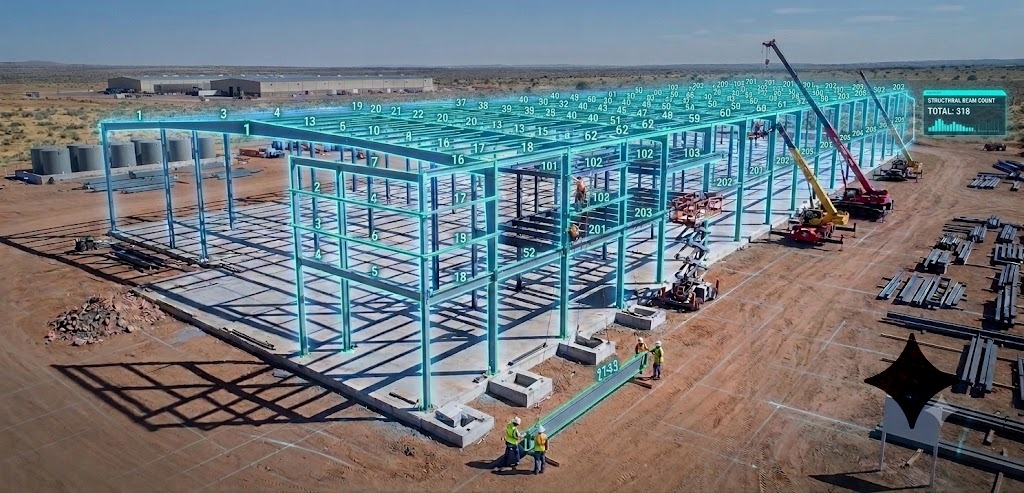
Visual detection overlays. SketchDeck overlays detected steel on your PDF drawings so estimators can see what the AI picked up and what it missed. Misclassifications and gaps are visible in context, not buried in a spreadsheet.
Structured BOM with traceability. SketchDeck generates a BOM with member types, sizes, lengths, weights, and attributes, and links every line item back to the exact source drawing location. Estimators can click from a suspicious BOM row to the drawing in one motion to confirm whether the AI interpreted the callout correctly. This is the core feature that makes exception-based review fast enough to actually do on every project.
Revision management. SketchDeck’s workflow for handling updated drawings is designed to show differences between versions so estimators can focus on changed areas. This addresses the highest-risk error category (working from an outdated set) by making the update process structural rather than manual.
Continuous improvement. SketchDeck’s models retrain based on customer corrections. The misclassifications your team flags today become training signal that improves accuracy on the next project. See Machine Learning in Construction: How SketchDeck Gets Smarter Over Time for more on this.
MSE’s published case study documents the result of this design in their workflow. Overall accuracy on AI takeoffs lands in the 95-99% range, which is what allows the team to use the AI output as a trusted baseline rather than a starting point that needs full re-verification. Read the full MSE case study.
For more on the underlying detection process, see How AI Reads Structural Steel Drawings and Computer Vision in Construction.
A Simple QC Checklist Steel Shops Can Adopt
Pulling together the research and practical workflow above, here is a steel-focused QC checklist for AI takeoff. Pin it to the wall next to the estimating workstation.
Before Running AI
- [ ] Confirm scope (what is included and excluded for this specific bid).
- [ ] Verify you are working from the latest drawing set.
- [ ] Note any alternates that should be carried separately.
After AI Generates the Takeoff
- [ ] Spot-check at least one frame or grid per main area against the BOM.
- [ ] Filter for outlier sizes and quantities. Investigate every flag.
- [ ] Verify a sample of connections and unusual details manually.
- [ ] Cross-check member attributes (camber, studs, piece marks) on representative items.
When Addenda Arrive
- [ ] Upload the new sheets immediately.
- [ ] Regenerate or update the takeoff.
- [ ] Re-check the high-impact areas where changes are concentrated.
- [ ] Document what changed and how the BOM updated.
Periodically
- [ ] Compare AI takeoffs against final as-built quantities or trusted manual baselines to track long-term accuracy.
- [ ] Document patterns where the AI is consistently weak and bake extra checks into the process.
- [ ] Update internal training so newer estimators inherit the QA discipline.
Used consistently with a tool like SketchDeck, this kind of checklist lets steel estimators capture the speed of AI while keeping tight control over quality. The goal is to catch AI errors before they reach the bid, protecting both margin and reputation.
The Bottom Line
AI takeoff is not error-free. It is also not error-prone in the same ways manual takeoff was. The shops that get the best results treat AI as a fast, consistent first pass and the human estimator as the discipline layer that catches what the model missed.
The research on hybrid human-AI workflows is clear: the combination outperforms either alone, but only if the human stays actively engaged. The QA discipline is what makes the speed gains safe. Without it, you trade old errors for new ones, often at a higher dollar value per mistake.
The first step is simple. Run an upcoming bid through SketchDeck in parallel with your current process, apply the QC checklist above, and see where the AI is strong, where it is weak, and where your team’s review catches what the model missed. You can start by booking a live demo.
Related reading
- The Ultimate Guide to Steel Estimating: Best Practices for Fabrication Success
- What AI Can and Cannot Do in Steel Estimating: Setting Realistic Expectations
- The Precision Gap: Why “Automated” Takeoff Software Is Failing Steel Estimators
- Accuracy Comparison: AI vs Manual Takeoff
- Speed vs Accuracy: Can You Have Both With AI?