

This article sits under The Ultimate Guide to Steel Estimating and walks through how to design a hybrid takeoff workflow that uses AI for the repetitive work and keeps estimators in control of the decisions that affect price, risk, and reputation.
What “Hybrid” Really Means in Steel Estimating
In steel estimating, a hybrid workflow means AI handles repetitive detection and counting while human estimators stay responsible for review, judgment, and final pricing.
In practice, that usually looks like:
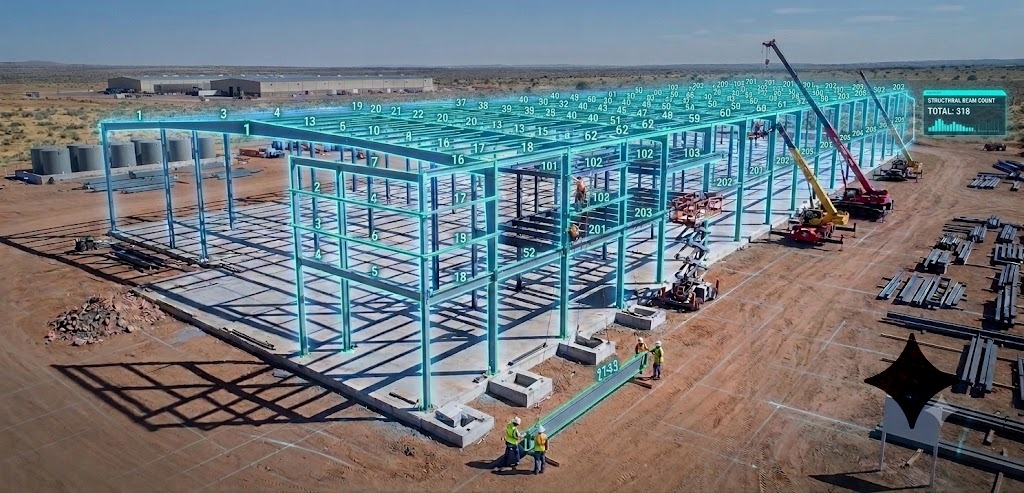
- AI runs first-pass takeoff from PDFs, detecting beams, columns, braces, and joists, and pulling attributes like size, length, studs, camber, and piece marks directly from labels.
- The estimator reviews, edits, and approves quantities, then applies pricing, risk assumptions, alternates, and project strategy.
- Data flows into existing tools (Tekla PowerFab, Strumis, Excel) for detailed estimating and detailing, instead of replacing your whole stack.
This is exactly how SketchDeck is built to work. It automates steel detection and BOM generation from drawings with about 95-99% accuracy on most clean digital projects, while still expecting a human estimator to review and finalize the takeoff. For a quick visual of the end-to-end flow, watch the 2-minute SketchDeck demo.
Why AI Alone Isn’t Enough
AI has become very good at reading structural drawings, but it still has clear limits that matter for real bids.
Common strengths:
- Fast detection at scale. AI takeoff tools can process full drawing sets in minutes instead of hours or days, often cutting estimating time by 50-80%. Autodesk’s research with Deloitte Access Economics found that preconstruction roles spend an average of 13.4 hours per week researching and analyzing data, much of which AI can absorb.
- Consistent counting. Once trained, AI applies the same rules on every sheet, which reduces random human errors and missed members.
- Attribute capture. Steel-specific AI can pull size, shape, camber, stud counts, and other label data, not just line lengths. We cover the underlying technology in Computer Vision in Construction: How AI Transforms Steel Takeoff from PDFs to BOMs and How AI Reads Structural Steel Drawings.
Typical limits:
- Context and scope decisions. AI cannot reliably decide which alternates are in or out, or how to treat vague scope notes that change the job. Autodesk’s analysis of AI in preconstruction is direct on this point: AI is becoming a partner that amplifies human decision-making, not a replacement for the estimator’s judgment.
- Messy or unusual drawings. Poor-quality scans, unusual symbols, or inconsistent labeling can reduce detection quality and still need human correction.
- Strategy and risk. AI does not understand your backlog, margin targets, or how aggressive you should be on a risky client or schedule.
Research published in Frontiers in Artificial Intelligence on hybrid augmented intelligence finds that humans excel at learning, reasoning, and collaboration, while AI offers normative, repeatable, logical processing. The best results come when AI does the heavy lifting and humans handle edge cases, interpretation, and final decisions. We unpack what AI can and cannot do in What AI Can and Cannot Do in Steel Estimating: Setting Realistic Expectations.
The Risks of an “AI-Only” Takeoff
Letting AI run without structured human review creates a different risk profile than traditional manual takeoff.
Key risks:
- Invisible errors. AI can confidently output wrong quantities or miss members, especially around complex connections or odd details, and those errors may not be obvious without checking. This is the core argument in The Precision Gap: Why “Automated” Takeoff Software Is Failing Steel Estimators.
- Over-trust in accuracy claims. 95-99% detection accuracy on most drawings still means 1-5% of items can be wrong or missing on a given sheet. That gap is where margin disappears.
- No project-specific judgment. AI cannot weigh local codes, field practices, or contractor preferences that affect means and methods and therefore cost.
This is why most construction and estimating experts recommend treating AI as a partner, not a replacement, and keeping a structured manual review step even when automation is mature.
When Full Manual Still Makes Sense
There are situations where manual-first, or even fully manual, estimating is still the safer choice.
Examples:
- Very small or simple projects. For tiny jobs or extremely simple frames, the setup and review overhead may outweigh time savings from AI.
- Poor-quality or non-standard drawings. If scans are unreadable, heavily marked-up, or use very unusual symbols, manual review may be faster than correcting AI output.
- New markets, specs, or systems. When entering a new structural system or code environment, estimators may want to manually validate assumptions before trusting automation.
Even in those cases, many shops still use hybrid tactics, like running the drawings through SketchDeck once to sanity-check manual counts or generate a baseline BOM for comparison.
Where Hybrid AI + Manual Review Wins
A hybrid model shines whenever the project is large or complex enough that pure manual workflows create delay and burnout, but you still need estimator judgment.
Situations where hybrid is ideal:
- Medium to large beam-heavy jobs where counting is the main bottleneck.
- Repetitive project types with familiar details, where AI can learn patterns and estimators can quickly spot outliers.
- Competitive bid cycles where response time and bid volume are critical to growth. Construction Dive’s analysis of preconstruction puts the structural shift bluntly: estimating capacity is now the core bottleneck in preconstruction.
Real-world examples from SketchDeck.ai:
- SSE Steel Fabrication cut estimating time by 50-80% using SketchDeck’s automated detection, freeing time for business development and higher-value analysis. Read How SSE Reduced Estimating Times by Up to 80% with SketchDeck.
- MSE has reduced beam takeoff time by up to 95% on certain projects and significantly increased bid output without adding headcount. Read the MSE case study.
In every case, estimators stayed in the loop: AI did first-pass takeoff, and humans still controlled adjustments, pricing, and final numbers. For more workflow examples, see How Steel Estimators Handle Complex Projects Without Burning Out.
Bringing this to your team? Change Management for AI in Steel Estimating: How to Bring Your Team Along covers how to introduce a hybrid workflow without triggering pushback from estimators.
What a Hybrid SketchDeck Workflow Looks Like
Hybrid is not a theoretical idea in SketchDeck. It is the default workflow.
1. Upload drawings. The estimator uploads PDF structural drawings (vector or scanned) into SketchDeck. The machine learning models scan each page and detect beams, columns, brace frames, joists, and other steel elements automatically.
2. AI detection and attribute capture. SketchDeck assigns element types and captures attributes like size, length, shape, camber, stud counts, and piece marks from labels. It also analyzes framing conditions and connection-related features like copes, holes, and moment frames on many drawings. For more on how the system improves over time, read Machine Learning in Construction: How SketchDeck Gets Smarter Over Time.
3. Estimator review and correction. The estimator reviews detected members on-screen, using group select and global edit to fix mislabels, apply company-specific naming, or adjust assumptions. Traceability between each BOM line and the drawing lets estimators click directly back to context instead of flipping through PDFs.
4. Generate and export BOM. Once satisfied, the estimator generates a structured BOM with weights and volumes and exports it into Tekla PowerFab, Strumis, Excel, or other downstream tools. This keeps detailed pricing, alternates, and buy-outs inside the tools the shop already trusts. For more on how SketchDeck handles weights, connections, and labor codes automatically, read Did You Know: How SketchDeck Automates Weights, Connections, and Labor Codes.
5. Handle revisions with overlay. When revised drawings arrive, Revision Management highlights differences between old and new sheets, so estimators can quickly update quantities instead of redoing the entire takeoff.
Deciding When to Lean on AI vs. Manual Review
A clear decision framework helps teams know when to push more work to AI and when to double down on human review.
Good triggers to lean harder on AI:
- High-volume beam and column jobs where counting is the main bottleneck.
- Repeat clients or repeat building types where you know the drawing style and already trust AI performance on similar work.
- Tight bid timelines where the choice is between using AI or missing the opportunity.
Good triggers to add extra manual review:
- New engineer-of-record with unfamiliar drawing standards and symbols.
- Critical or high-risk projects where missing a connection or misreading a note could have major cost impact.
- Poor-quality scans or heavily marked-up PDFs where even human reading is difficult.
If you are not sure where your team currently sits, 5 Signs Your Steel Estimating Process Is Ready for an AI Transformation is a useful checklist.
How to Structure Manual QA Around AI
In a hybrid model, the goal of manual review is not to redo the entire takeoff but to systematically check and approve AI output.
Practical QA patterns:
- Targeted sampling. Pick representative frames, high-load areas, and complex connections and manually recount them to compare against AI quantities.
- Exception-based review. Use AI-generated reports and filters to focus on unusual sizes, odd quantities, or members that do not fit typical patterns.
- Standard checklists. Maintain a checklist of items AI can struggle with (miscellaneous steel, odd plate shapes, certain connection types) and always review those by hand.
Because SketchDeck keeps traceability between BOM items and drawing views, estimators can jump directly from a questionable line item back to the exact drawing context instead of flipping manually through sheets. This keeps QA time predictable while still significantly reducing total effort compared to pure manual workflows. For the broader case for moving away from spreadsheet-only estimating, see Building a High-Performance Steel Estimating Workflow.
Making Hybrid Part of Your Team Culture
A hybrid approach works best when estimators see AI as a way to protect their expertise, not replace it.
Helpful cultural messages:
- “AI takes care of counting; estimators take care of judgment.” This keeps ownership of the bid with the human team.
- “Manual review is how we teach the system.” When estimators correct AI output and give feedback, tools like SketchDeck can improve performance on future projects.
- “We use AI so we can choose better work.” Faster, more accurate takeoffs let leadership evaluate more opportunities and be more selective, supporting estimator job satisfaction and company margins.
Many early adopters report that once estimators experience time savings, often 50-75% or more on typical takeoffs, they become strong advocates for the hybrid model because it lets them focus on higher-value work. For the change management side, see Change Management for AI in Steel Estimating and Why 95% of AI Projects Fail (And How We’re Part of the 5% That Doesn’t).
Where SketchDeck Fits in Your Hybrid Roadmap
For a fabricator moving toward a hybrid AI/manual review model, SketchDeck usually becomes the engine at the front of the estimating process.
In that roadmap, SketchDeck acts as:
- The AI reader of drawings, turning PDFs into structured steel data (sizes, weights, connections, quantities) in minutes.
- The BOM builder, standardizing how material is organized and named before it hits Tekla PowerFab or other downstream systems.
- The revision manager, using overlay and change-handling features to remove most of the rework when drawings change late in the bid cycle.
Because SketchDeck integrates with common estimating and fabrication tools, adopting a hybrid model does not require ripping out your current stack. It just replaces manual counting and spreadsheet gymnastics at the front end. We cover the integration angle in detail in How AI Integration Transforms Existing Steel Estimating Workflows Without Disrupting Your Team.
For most teams, the first step is simple: run an upcoming bid through SketchDeck in parallel with your current process, compare time and accuracy, and then decide where AI and manual review each add the most value. You can start that by booking a live demo.
Related reading
- The Ultimate Guide to Steel Estimating: Best Practices for Fabrication Success
- Change Management for AI in Steel Estimating: How to Bring Your Team Along
- What AI Can and Cannot Do in Steel Estimating: Setting Realistic Expectations
- The Precision Gap: Why “Automated” Takeoff Software Is Failing Steel Estimators
- How AI Integration Transforms Existing Steel Estimating Workflows Without Disrupting Your Team