
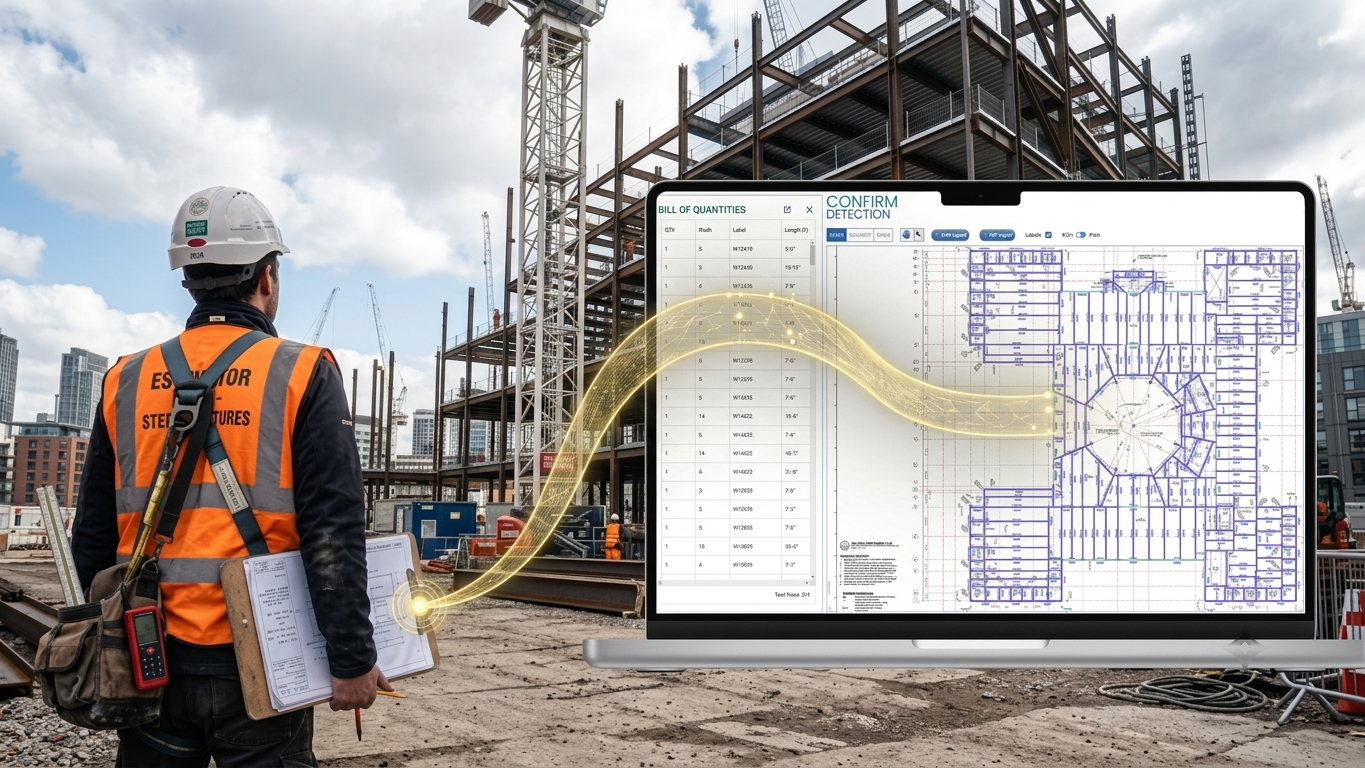

The estimator who has been counting members manually for fifteen years gets the news on Monday morning: "We are adding AI estimating software." The immediate questions are the same in every shop. Will I look incompetent during the learning curve? Will my job become obsolete? Will we submit bad estimates and lose client trust during the transition?
These are not unreasonable concerns. They are exactly the concerns that have stopped many shops from modernizing even when they recognize the need. The estimators who built successful careers on careful manual takeoff are right to be skeptical of "just install the software" advice. Transitions go badly when the technical side gets all the attention and the human side gets ignored.
This article is the practical roadmap for shops that have decided to modernize and want to do it without disrupting current operations or damaging client relationships. The framework treats transition as organizational change, not just software installation, and provides specific milestones, validation checkpoints, and timeframes drawn from how LIFT customers have actually run the move from manual methods to AI-assisted estimating.
This article sits under Building a High-Performance Steel Estimating Workflow and is the implementation-focused companion to the broader workflow design covered in the pillar.
The structural reality of the steel estimating labor market is the case for transition that no software vendor needs to make.
Construction Dive's analysis of the estimator talent gap cites AGC data showing one in four construction workers is over 55, and the BLS projects 41% of the current workforce could retire by 2031. The BLS Occupational Outlook Handbook projects cost estimator employment to decline 4% from 2024 to 2034, with software cited explicitly as a primary productivity driver.
Translation: the experienced estimators you would want to hire are aging out faster than they are being replaced. The shops that successfully modernize their estimating capacity over the next five years will have a structural advantage over the shops still running entirely on manual methods. The transition is not optional for any shop planning to be operating at scale in 2030. It is a question of when and how, not whether.
The Stanford Digital Economy Lab's research on AI augmentation versus automation makes the argument empirically. When AI use is augmentative, supporting existing expertise rather than replacing it, employment in that occupation grows. The estimators who adopt AI tools well do not become obsolete. They become more valuable because they handle more bid volume with better strategic focus on the work that requires their judgment.
That is the right framing for the conversation with your team. AI is not the replacement. AI is the lever that makes experienced estimators harder to lose.
The single most common mistake in any technology transition is purchasing before assessing. The right starting point is a clear picture of where your estimating process actually spends time and where the bottlenecks live.
Document your existing workflow step by step. Where does the time actually go on a typical bid? How many hours per estimate on takeoff specifically, versus pricing, versus review, versus communication?
Identify your biggest pain points. Speed? Accuracy? Consistency across estimators? Capacity ceiling? Different pain points warrant different solutions. A shop with a speed problem and a shop with a consistency problem will evaluate the same software differently.
Evaluate your team's technology comfort level honestly. Veteran estimators using spreadsheets and PDF markup tools have different transition needs than estimators already running model-based workflows. The honest assessment shapes the rollout plan.
Calculate your current cost per estimate. The BLS Occupational Outlook Handbook puts the median annual wage for cost estimators at $77,070, or $37.05 per hour, as of May 2024. Loaded with benefits and overhead at the typical 1.3-1.5x multiplier, fully loaded cost lands in the $48-$56 per hour range. Multiply by hours per estimate and you have a real number for what each bid currently costs to produce.
Establish baseline metrics. Estimates per week, average completion time, current win rate, variance between estimated and actual on won projects. You need these baseline numbers to measure transition success in six months.
Define what success looks like. Concrete and measurable, not aspirational. "Reduce average takeoff time by 50% on bids under 200 tons" beats "improve estimating efficiency" because you will know if you got there.
For more on whether your shop is genuinely ready for this kind of transition, see 5 Signs Your Steel Estimating Process Is Ready for an AI Transformation.
Not all automation is equal. The right tool depends on what your shop actually needs and how your team currently works.
Understand the technology spectrum. Traditional takeoff software still requires the estimator to do the detection work. AI-powered automation handles the detection and lets the estimator focus on review and judgment. These are fundamentally different approaches with different implementation profiles. For a fuller view of what AI actually does on a steel drawing, see How AI Reads Structural Steel Drawings and Computer Vision in Construction.
Evaluate based on your specific needs. Smaller shops bidding simpler structures have different requirements than large shops doing complex industrial work. The software that wins your evaluation should reflect your actual project mix, not a vendor's pitch deck.
Look for solutions that learn your methodology. The right tool adapts to how your shop already categorizes connections, names members, and structures BOMs. Tools that force you to abandon proven approaches add unnecessary friction.
Assess implementation support honestly. Vendor ghosting after the contract signs is one of the most common reasons transitions fail. Ask specific questions: who supports us during the first 90 days? What does training look like? What is the response time on technical issues? Get the answers in writing before you sign.
Consider integration requirements. Your AI takeoff tool needs to feed Tekla PowerFab, your estimating database, and your ERP system without requiring manual retyping. Integration friction is a major source of post-purchase regret. For more on integrating AI into existing workflows, see How AI Integration Transforms Existing Steel Estimating Workflows Without Disrupting Your Team.
Validate with reference customers in similar situations. Talk to shops similar to yours that have completed the transition. Ask honest questions: what surprised you? What would you do differently? How long did it actually take to feel confident? Vendor case studies are useful, but reference calls produce the real story.
Technology transitions fail more often on the people side than the technical side. The shops that succeed treat their estimating team as experts and partners in the rollout, not as recipients of change to be managed.
Communicate the "why" honestly. The conversation is not "we are upgrading to better software." The conversation is "we need to bid more work to grow, and we cannot hire our way there given the labor market. AI lets us do that without replacing anyone." Anchor that conversation in the structural reality cited above: estimator shortages, aging workforce, and the strategic need to multiply existing capacity. For more on this framing, see Will AI Replace Estimators? An Honest Look at the Future of Steel Estimating.
Involve estimators in evaluation and selection. They are the experts on what the work actually requires. Decisions made without them produce tools that look good in demos and fail in production. Decisions made with them produce buy-in that becomes adoption.
Address job security concerns directly. The honest answer is that AI is a capacity multiplier, not a headcount reducer. Shops adopting AI well are growing bid volume, taking on larger projects, and expanding geographies. All of these require more estimating talent, not less. Show the growth plan that the freed capacity enables. For a deeper look at this dynamic, see Will AI Replace Estimators? An Honest Look at the Future of Steel Estimating.
Identify your internal champion. Every successful transition has at least one estimator who gets excited about the efficiency and becomes the daily evangelist for the team. They are not usually the most senior person. Look for the estimator who is curious about new tools and respected by peers.
Set realistic expectations for the learning curve. The first two weeks feel awkward. The first month is roughly break-even on time. The dramatic capacity gains arrive in months two and three when the team has built fluency with the tool. Underpromising and overdelivering is far better than overpromising and disappointing.
Plan for different adoption speeds. Some estimators adapt in days. Others need months. Both patterns are normal. The rollout plan should accommodate both, with the fast adopters helping the team learn while slower adopters get the runway they need.
Frame the change in terms of what gets reclaimed. AI handles the tedious detection work. Estimator expertise applies to project qualification, scope interpretation, pricing strategy, and bid quality. The reframe is straightforward: AI removes the parts of the day that did not require your judgment, freeing you to focus on the parts that did.
For more on the broader change management approach, see Change Management for AI in Steel Estimating: How to Bring Your Team Along.
The structural principle of a safe transition: run the new system alongside the old one until you have validated accuracy on real projects. Never submit an automated estimate to a client until your team has confirmed the output independently.
A practical phased timeline aligned with the four-function structure in the NIST AI Risk Management Framework (Govern, Map, Measure, Manage):
Phase 1 (Weeks 1-2): Training on simple projects with no deadline pressure. The first projects through the tool should be ones where mistakes will not cost a client or trigger rework. Budgetary estimates, projects you have already won (for comparison against known results), and smaller standard buildings work well here. Document every step and every question that arises.
Phase 2 (Weeks 3-4): Parallel processing. Run estimates both ways. AI takeoff plus manual takeoff on the same project. Compare results explicitly. Where do the numbers agree? Where do they diverge? Understanding the divergence patterns is what builds team confidence in the AI output and identifies where extra review attention belongs.
Phase 3 (Weeks 5-6): Assisted live use. Use AI as the primary takeoff method but with deliberate manual review of complex areas, unusual conditions, and high-impact items. The team is no longer doing the work twice but is still validating every bid before submission.
Phase 4 (Weeks 7-8): Primary system with spot-check validation. The team uses AI as the default and spot-checks representative samples. Review effort focuses on the small percentage of items the system flagged or that estimator judgment flags during the review pass.
Phase 5 (Weeks 9-12): Full adoption with continuous improvement feedback. Document patterns where the tool was consistently strong, where it needed more review, and where the team's institutional knowledge updated as a result. This becomes the feedback loop that continues improving the system over time.
Three rules apply throughout. Never submit an automated estimate without internal validation. Keep manual capability available as a backup throughout the transition (the safety net reduces anxiety, which speeds adoption). Document learnings weekly so institutional knowledge accumulates as a team resource rather than as individual experience.
For more on the underlying QA discipline that makes this validation work, see AI Errors and How to Catch Them: Quality Control Best Practices and Double-Checking Your Work: QA/QC Workflows for Takeoffs.
The transition succeeds when the team trusts the output. Trust comes from validation, and validation comes from running enough projects through the tool to see consistent patterns.
Compare automated takeoffs to manual on 10-15 projects before going fully live. The number is not magic; the principle is that one or two comparisons is not enough data to evaluate a system. Ten to fifteen projects across your typical project mix tells you where the tool is consistently strong and where it needs more review attention.
Focus on percentage accuracy, not exact match. The expectation should not be that the AI counts exactly the same number of beams the estimator counted. The expectation is that the AI output is within a tight tolerance of estimator-verified counts on representative samples. A small percentage variance on standard members is normal and trivially correctable in review.
Identify systematic variances. Does the tool consistently miss a specific element type? Does it over-count a particular category? Systematic patterns are the most valuable validation findings because they tell the team exactly where to focus review attention going forward.
Calibrate the system to your methodology. Your shop's connection counting rules, member categorization logic, and BOM conventions are the standards the tool should align with. Most AI estimating tools support customization. Use it. For more on how this customization works in LIFT specifically, see Did You Know: How to Customize Your Quantities Panel in LIFT and Did You Know: How LIFT Automates Weights, Connections, and Labor Codes.
Review with your most experienced estimators. They will spot quirks that less experienced estimators miss. Validation is exactly the kind of work that pays off the experience the senior team brings to the shop.
Use early wins to build team confidence. When an automated estimate proves accurate on a complex project, celebrate it publicly. When the tool catches something a manual approach would have missed, name it. Confidence builds when wins are visible.
The detection accuracy on most LIFT projects lands in the 95-99% range per SketchDeck product documentation. That is the baseline the validation work should be confirming on your specific drawings and project types, not assuming.
The dramatic capacity gains arrive at 60-90 days, not on day one. The shops that pace expectations correctly capture those gains. The shops that expect overnight transformation either declare failure too early or run the rollout too aggressively and damage trust.
Measure time savings against your baseline. Where did the reclaimed hours actually go? Some shops use freed time for more bids. Others use it for higher-quality review and stronger client communication. Both are legitimate, but the choice should be deliberate, not accidental.
Track capacity increase. Estimates per week now versus before the transition. If this number is not changing, something in the workflow is consuming the time savings.
Monitor win rate changes. Faster, more accurate takeoff often improves win rate over time because estimators have more time for the strategic and pricing work that actually wins bids. Track this. The change might be subtle at first.
Calculate ROI honestly. Time saved multiplied by loaded labor cost versus software cost gives you the basic financial picture. For a full ROI framework with worked examples, see AI ROI Calculator: Estimating Your Potential Capacity Gain.
Identify new opportunities enabled by speed. Faster takeoff lets you bid smaller projects profitably, respond to rush RFQs, and pursue work in geographies that previously required too much travel time. These second-order benefits are often where the transition's largest value lives.
Expand usage to more estimators and project types. Once the rollout has succeeded with the initial team, scale it across the department. The earlier adopters become the trainers for the next wave.
Build new workflows around increased capacity. What can your shop do with 50% more bid volume? Pursue larger projects? Expand into new geographies? Take on rush estimates competitors decline? Plan deliberately rather than letting the capacity dissipate into general overhead.
For more on what capacity multiplication looks like at scale, see How AI Multiplies Estimator Capacity (With Real Examples) and Breaking the Headcount Barrier: Scaling Bids Without Hiring.
The pattern across LIFT customers is consistent: shops that ran disciplined transitions captured large capacity gains. Shops that tried to rush the rollout slowed themselves down.
Maccabee Industrial is the clearest documented example of a structured transition. Their published case study documents 75% time savings on large projects, 50% overall speed improvement, and full team adoption within four months. Don Fleszar, one of their estimators, framed the math behind the decision directly:
"If we can increase the number of bids we put out by 50 to 100 percent, we're going to increase the amount of work we have equivalently."
Maccabee estimator Dawn Hargraves captured the partnership model in her own words:
"I actually appreciate that it's not 100% perfect because it keeps me engaged and checking the work. We can catch any issues while still saving massive amounts of time."
This is exactly the dynamic the human-in-the-loop research literature identifies as the highest-performing configuration. AI provides the consistent baseline. The estimator's review is the discipline that catches what the AI missed. Read the full Maccabee case study.
MotionSteel adopted LIFT after retirements and resignations left them short-staffed. Their case study documents going from 30-40 estimates per month to about 70 estimates per month with the same core team, more than doubling bid volume. General Manager Jay Livesey:
"It was a no brainer. I've been estimating for probably 8 years using just the good ol' highlighter and paper, wishing for a program that could automate this process."
The MotionSteel case is the strongest documented example of using AI transition to solve the headcount-replacement problem the labor market is creating. Read the full MotionSteel case study.
All five shops followed broadly similar patterns: deliberate phased rollout, parallel validation, full team adoption over weeks rather than days, and capacity gains that built over months rather than appearing overnight. The transition discipline is what made the capacity gains durable.
Wondering whether your team is ready for this kind of structured transition? 5 Signs Your Steel Estimating Process Is Ready for an AI Transformation is a quick gut-check before you start.
Pattern recognition from how transitions go wrong is just as valuable as the framework above.
Rushing the rollout. Pressure to "see results immediately" compresses the validation phase, which then erodes trust when surprises surface. Commit to the 90-day window and protect it.
Skipping the parallel system phase. This is the single most common transition mistake. The shop installs the software, runs a few takeoffs, and goes live. The first significant variance from manual takeoff creates panic, and the team retreats to manual methods. Parallel validation prevents this.
Treating the transition as a technical project. Software installation is the easy part. Change management is the hard part. Shops that staff and fund only the technical side underinvest in the work that actually determines success.
Underestimating the learning curve. Two-week-long awkward periods are normal. Four-week-long awkward periods are normal. Twelve-week-long awkward periods are not. If the team is still struggling at week 12, either the training has not been adequate or the wrong tool was selected.
Failing to communicate the "why." "We are switching to new software" is not a reason. "We need to bid more work to grow, and AI is how we do that without hiring estimators we cannot find" is a reason. The clarity of the strategic story shapes how the team engages with the change.
Not celebrating early wins. Confidence builds when wins are visible. When the AI catches something manual would have missed, name it. When an automated estimate proves accurate on a complex project, share it. The shops that build a culture of small public wins finish the transition faster than the shops treating it as a quiet operational change.
The transition from manual to automated steel estimating is organizational change, not just software installation. The shops that succeed run structured rollouts: clear baseline assessment, deliberate tool selection, deep team engagement, phased implementation with parallel validation, honest accuracy checking, and patience for the capacity gains to mature over 60-90 days.
The structural reality of the steel estimating labor market makes the transition increasingly urgent. The estimators you would want to hire are aging out faster than they are being replaced. AI is the lever that lets your existing team bid the volume your shop needs to grow.
If you want to test what a structured transition looks like on your own projects, the simplest move is to run an upcoming bid through LIFT in parallel with your current process. The parallel validation is the first phase of the transition framework above. You can start by booking a live demo.


