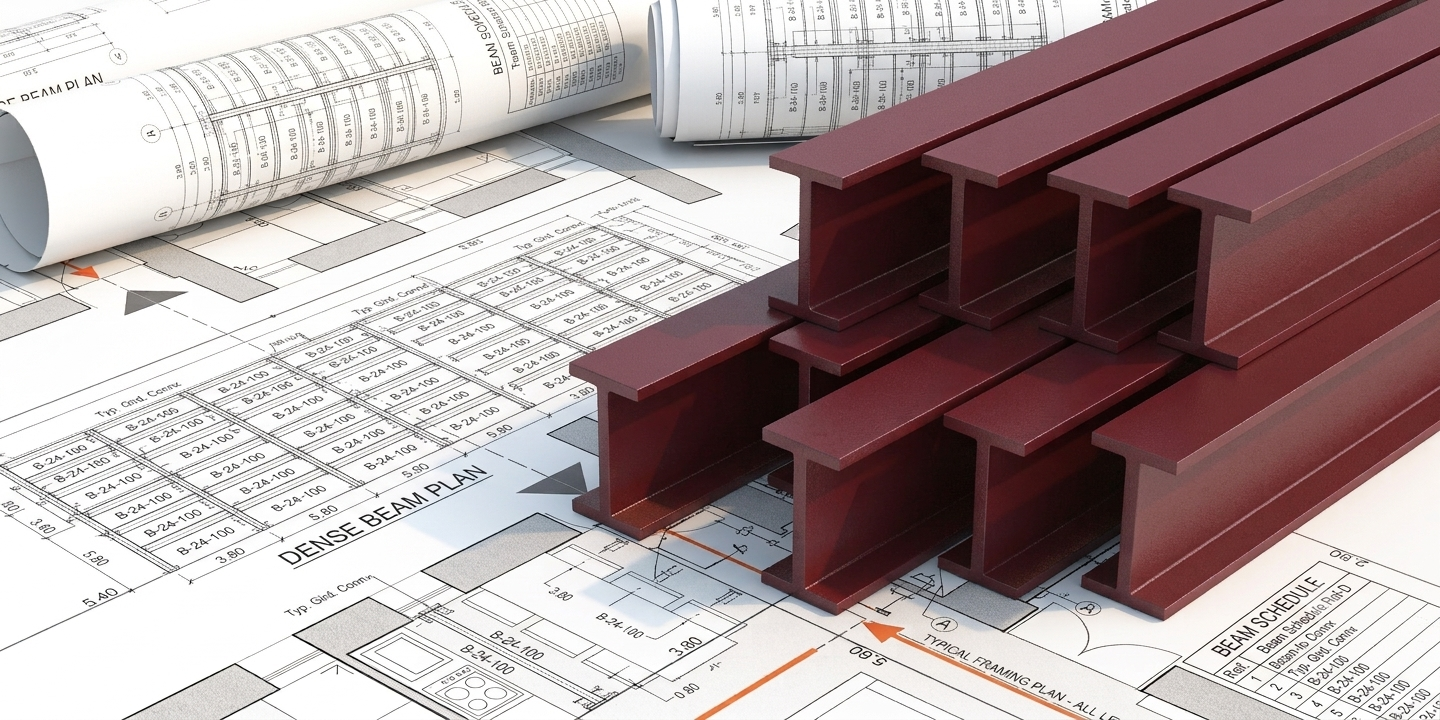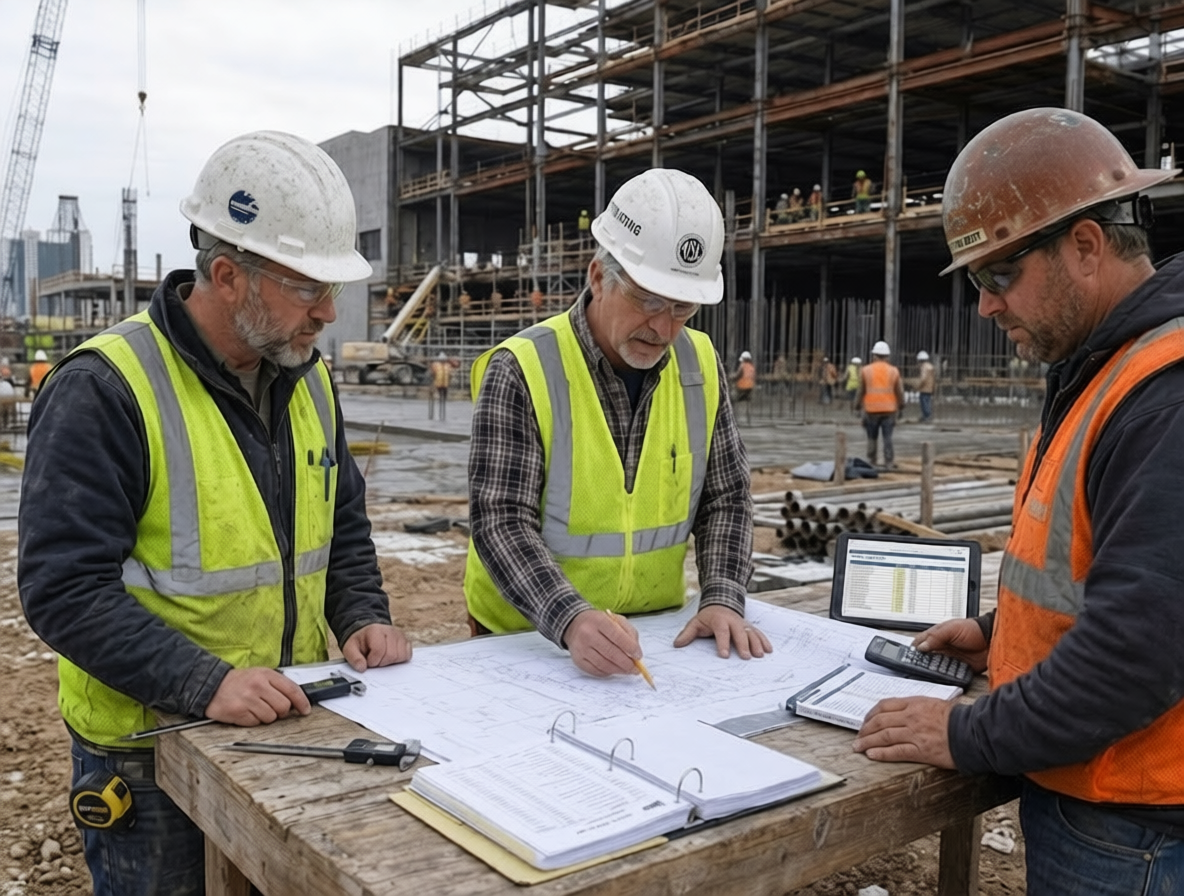

The bid window is rarely generous. Major projects routinely arrive with hundreds of pages of drawings and a deadline measured in days, not weeks. The estimators who consistently win profitable work do not panic when those RFPs land. They run a system that turns a chaotic bid cycle into a repeatable workflow with clear stages, defined handoffs, and structured verification at each step.
This article walks through the seven-stage workflow experienced estimating departments use to take a bid from RFP receipt to submission. The principles apply at any shop size, and the workflow scales with technology rather than against it. AI tools like LIFT accelerate specific stages without changing the underlying discipline.
This article sits under Building a High-Performance Steel Estimating Workflow and is the stage-by-stage companion to the broader workflow design covered in the pillar.
The economics of bidding are unforgiving. Steel estimators handle a high volume of RFPs across the year, each consuming meaningful hours, and the win rate on those bids determines whether the estimating department contributes to margin or eats into it.
According to McKinsey Global Institute's research on knowledge worker productivity, the average interaction worker spends nearly 20% of the workweek looking for internal information or tracking down colleagues who can help with specific tasks. For estimating departments running on bid deadlines, that lost time is exactly the capacity that could have gone toward submitting another bid.
The BLS Occupational Outlook Handbook puts the median annual wage for cost estimators at $77,070, or $37.05 per hour, as of May 2024. Loaded with benefits and overhead at the typical 1.3-1.5x multiplier, the fully loaded cost lands in the $48-$56 per hour range. Every hour that goes into a low-probability bid is an hour not going into a high-probability one. Workflow design is what allocates that scarce time where it has the most impact.
The CFMA Construction Financial Benchmarks Report shows industry net profit margins running around 5-6%, with specialty trades at around 6.9%. At those margins, the difference between a structured workflow and an ad-hoc one shows up directly in annual profit.
The moment an RFP arrives starts the clock. What happens in the first two hours often determines whether the project is worth pursuing at all.
Open the RFP. Do not read it line by line yet. Scan it for the structural red flags that should pause the bidding decision.
Look for:
Three or more meaningful red flags is usually a signal to decline. The most expensive estimates are the ones that should never have been bid in the first place.
A simple scoring framework forces consistent qualification decisions instead of gut-feel responses. Each shop's specific thresholds will differ, but the structure works the same way:
Document the scoring on every bid you consider. Over a year, the data tells you which project types win at acceptable margins and which consume estimating hours for no return.
For more on the qualification step and bid volume strategy, see The Essentials: 10 Steel Estimating Best Practices Every Estimator Should Use.
If the project moves forward, assign resources immediately:
Send calendar invites for key milestones — drawing review complete, takeoff complete, pricing complete, final review and submission. Lock the times in early before competing priorities fill the calendar.
This is where amateur effort ends and disciplined estimating begins.
Never start counting until you understand the project. The pre-takeoff verification covered in Steel Takeoff Checklist: What Every Estimator Should Verify applies here.
Print or digitally mark the drawing index. Check off each drawing as you review:
For each drawing, note revision number, unusual conditions, missing information, conflicting details, and special requirements. If drawings reference specifications you do not have, stop. Request them before proceeding.
Most RFIs get ignored because they are poorly written. The format that gets timely responses includes:
Submit RFIs within 24 hours of RFP receipt. Late submissions rarely get answered in time.
Specifications hide expensive requirements that drive bid accuracy. Read these sections first.
Division 05 — Metals. Material grades (A992 vs A36 affects pricing per the AISC and ASTM standards covered in Material Classification Best Practices: Plates, Angles, Channels, and More). Coating requirements. Inspection requirements (affects shop scheduling). Delivery requirements. Warranty terms.
Division 01 — General Requirements. Insurance, bonding, schedule constraints, site access, safety. Missing any of these makes the bid either non-compliant or underpriced.
The ANSI/AISC 303-22 Code of Standard Practice for Steel Buildings and Bridges is the default framework everyone in the contract chain assumes. Deviations from AISC 303 are scope events the estimator needs to flag, not absorb.
This is where bids are won or lost. Accurate quantities drive everything downstream.
Do not jump randomly through drawings. The systematic sequence below prevents double-counting and missed items:
Use a consistent coding system across projects so review and follow-up questions become traceable:
This coding pays dividends during peer review and when answering scope questions weeks after submission.
Every few hours of takeoff, pause and run sanity checks against your shop's historical data on similar projects. The right benchmarks are your own historical ratios — weight per square foot, connection counts, miscellaneous percentage — not published industry rules of thumb. A retail warehouse, a multi-story office, a hospital, and an industrial facility produce dramatically different ratios.
If your numbers fall outside your historical range for this building type, investigate before continuing.
For more on AI-assisted takeoff that handles the high-volume detection work, see How AI Reads Structural Steel Drawings and Computer Vision in Construction.
Quantities are facts. Pricing is strategy.
Never use last month's prices for this month's bid. Steel commodity markets move with mill availability, freight markets, and trade conditions.
Base material. Call three suppliers minimum. Get prices for the specific shapes in this project, not generic averages. Lock pricing where possible. Add escalation provisions for projects with long fabrication windows.
Secondary material. Bolts, welding consumables, shop primer, and miscellaneous items each carry their own pricing logic. Track these against your shop's actual project history rather than applying rule-of-thumb percentages.
Special materials. Galvanizing, AESS-grade finishing per the AISC Code of Standard Practice, stainless steel, and specialty grades all carry premium pricing that varies by supplier and region. Get current quotes; do not estimate from memory.
Labor is where pricing accuracy lives or dies, and where shop-specific historical data matters most. Generic published labor hour ranges vary so widely by shop, region, project type, and automation level that applying them as cost baselines is unreliable.
The disciplined approach is to track your shop's historical production rates over time:
Apply adjustment factors qualitatively for project conditions that drive labor higher: congested sites, winter construction, night work, occupied facilities, restricted crane access. The exact adjustment percentages should come from your shop's actual variance data, not from generic rules of thumb.
For more on building this institutional knowledge, see The Essentials: 10 Steel Estimating Best Practices Every Estimator Should Use.
Equipment, transportation, and site costs often get rushed at the end of pricing and consistently underestimate complex projects. Build these into the pricing model with current rates from your suppliers, not estimates from memory:
Region and project-specific. Get current quotes during pricing, not at submission time.
Wondering whether your shop is ready to systematize this workflow? 5 Signs Your Steel Estimating Process Is Ready for an AI Transformation gives a quick gut-check.
A great estimate poorly presented loses to a good estimate well presented.
Lead with strength. The first page contains the information the decision-maker needs in 30 seconds:
Keep it to one page. Executives rarely read past that.
Summary level: material, labor, equipment, subtotal, overhead and profit, total.
System level: columns and bases, beams and girders, bracing and connections, stairs and rails, miscellaneous.
Detailed backup: only if requested. Contains complete quantity lists, unit prices, labor calculations, equipment schedules.
Match the level of detail to what the GC actually wants. Over-disclosing on a competitive bid can erode pricing power; under-disclosing can lose the bid on appearance of opacity.
This section protects your margin. Be specific. Vague exclusions get ignored.
Clarifications:
Exclusions:
Differentiate by offering structured alternatives:
Concrete cost differences for each option, not vague "savings opportunities." Specificity signals you have actually thought through the alternatives.
The most expensive mistakes are caught here, or not caught at all. For the complete QA/QC framework, see Double-Checking Your Work: QA/QC Workflows for Takeoffs.
Pass 1: Math check. Verify all calculations. Check unit conversions. Confirm extensions. Validate totals.
Pass 2: Scope check. Every drawing covered? All specifications included? RFI responses incorporated? Nothing double-counted?
Pass 3: Competitive check. Price per ton reasonable for the project type? Margin appropriate for the risk profile? Comparable to your historical data on similar projects?
Each pass by a different person if your team size allows. Different reviewers see different things.
Errors that hide until final review:
Create a structured checklist for the final review. Use it on every bid. The discipline is the value.
According to the Construction Industry Institute, rework represents between 2% and 20% of total project costs, with an average of 12%. Catching errors at this stage is dramatically cheaper than catching them during fabrication or in the field. The QC investment pays for itself many times over.
The bid is not done when you click submit.
24 hours before deadline. Prepare the submission package. Get signatures. Create PDF copies. Test the upload portal.
2 hours before deadline. Final review. Upload or submit. Get confirmation. Send a backup email.
Never wait until the last hour. Portals crash. Internet connections fail. Email bounces. Time pressure compounds errors.
Day of submission. Email confirming receipt: "Confirming receipt of our bid for [project]. Please confirm receipt."
Day after deadline. Phone follow-up: "Following up on our submission. Any questions we can clarify?"
One week later. Email check-in: "Checking on bid evaluation timeline. We remain very interested."
After award (win or lose). Request feedback: "Could you share feedback on our bid?"
The follow-up discipline differentiates your shop from the bids that go in and disappear. Sales relationships compound over years; lost bids today become won bids tomorrow when the relationship is maintained.
The seven-stage workflow above represents disciplined manual practice. AI takeoff tools do not replace the workflow. They accelerate the stages where high-volume repetitive work consumes the most estimator time.
Stage 1 (RFP assessment). Upload drawings for faster scope and complexity assessment. The qualification decision still requires estimator judgment, but the inputs to that decision arrive faster.
Stage 3 (Quantity takeoff). This is where AI provides the biggest time reduction. Detection of beams, columns, braces, connections, and standard miscellaneous steel happens in minutes instead of hours. The estimator focuses review effort on the complex items the AI flagged.
Stage 6 (QC review). The structured BOM with traceability back to the drawing makes peer review faster and more focused. Instead of recounting from scratch, the reviewer clicks from a suspicious BOM row to the drawing in one motion.
Detection accuracy on most LIFT projects lands in the 95-99% range per SketchDeck product documentation, with the small percentage requiring manual review being the items where estimator judgment was already required.
AI changes the speed of high-volume detection. It does not change the workflow stages that require judgment: project qualification, scope interpretation, pricing strategy, value engineering, bid presentation, and follow-up. Those stages still belong to the estimator.
This is the partnership model the human-in-the-loop research literature consistently identifies as the highest-performing configuration. Maccabee estimator Dawn Hargraves described the dynamic directly:
"I actually appreciate that it's not 100% perfect because it keeps me engaged and checking the work. We can catch any issues while still saving massive amounts of time."
The pattern across LIFT customers is consistent: AI accelerates the stages of the workflow that consumed the most estimator time, freeing capacity for the high-judgment work.
LIFT does not require abandoning your current systems. It exports directly to Tekla PowerFab, Excel templates, and other tools in your estimating stack. Your existing workflow stays in place. The AI just completes the takeoff stage faster.
For the broader case on adopting AI without disrupting workflows, see How AI Integration Transforms Existing Steel Estimating Workflows Without Disrupting Your Team.
Week 1: Document current state. Time each stage of your current process. Identify bottlenecks. Calculate actual bid costs per project. Determine your current win rate by project type.
Week 2: Optimize manual processes. Implement go/no-go scoring. Create RFI templates. Standardize pricing inputs. Build QC checklists.
Week 3: Test automation. Trial LIFT on one project. Compare time and accuracy. Identify integration points. Calculate the actual ROI for your shop on your specific project mix.
Week 4: Scale implementation. Train the team on the new workflow. Establish KPIs to track. Monitor improvements. Refine the process based on what is working.
For more on managing this kind of change at the team level, see Change Management for AI in Steel Estimating: How to Bring Your Team Along.
The ideal steel estimating workflow is not about working harder. It is about working systematically. Every stage has a purpose, every checkpoint prevents downstream errors, and every optimization compounds across the dozens or hundreds of bids your shop runs per year.
The seven-stage framework is the structure. AI tools accelerate the stages where high-volume work consumes the most estimator time. Your shop's expertise still owns the judgment-intensive stages where bids are actually won or lost.
If you want to test what AI-assisted workflow acceleration looks like on your own projects, the simplest move is to run an upcoming bid through LIFT in parallel with your current process. Measure both the time investment and the accuracy of the output. You can start by booking a live demo.