
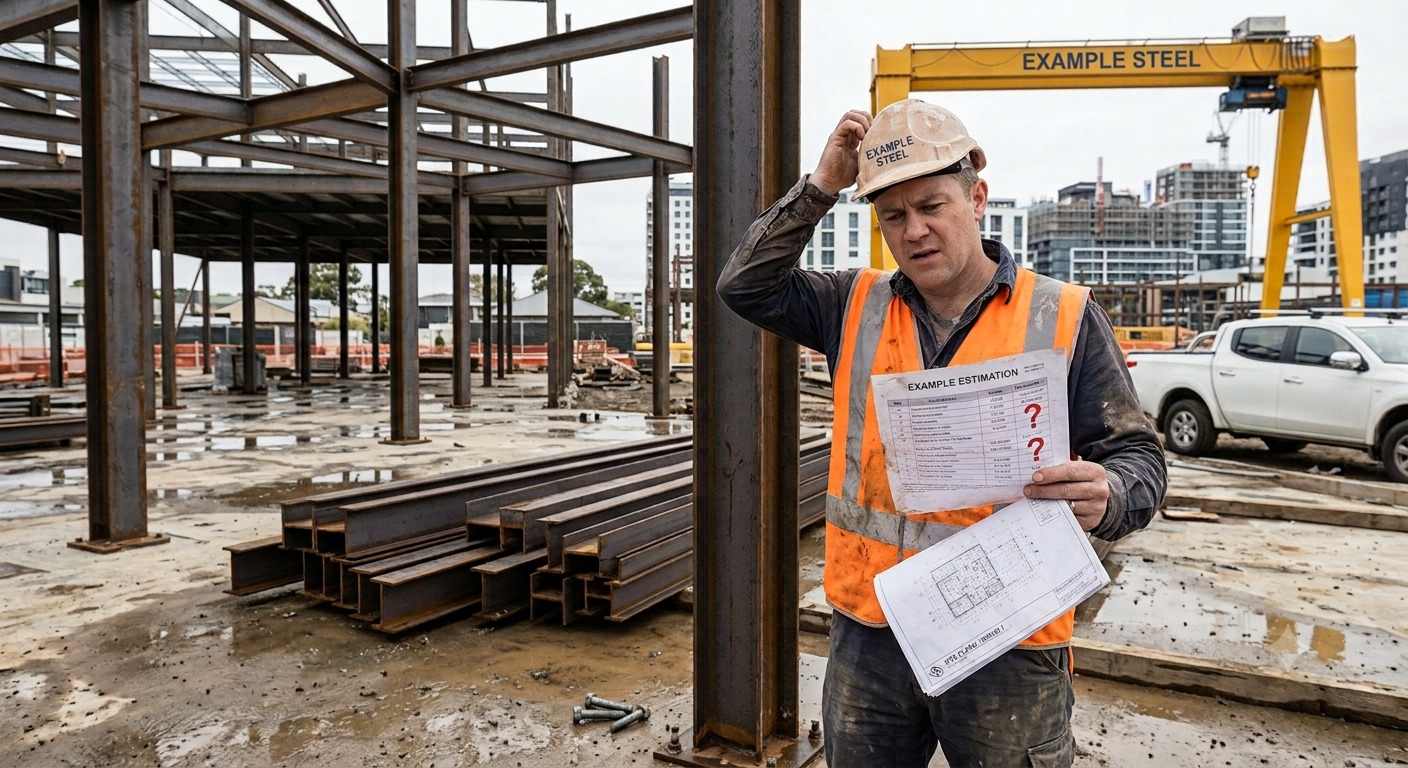

Steel takeoffs are the foundation of every profitable bid. They are also where the most expensive mistakes get made. A single missed connection plate, a misclassified beam, or a missed drawing revision can trigger material shortages, schedule disruptions, and margin loss that no amount of pricing skill downstream can recover.
Every experienced estimator has stories about takeoff errors that cost real money. The pattern is consistent across shops: the errors are not random, they are predictable failure modes that recur across projects. Once you know which patterns to defend against, most of them are catchable at the takeoff stage where they are still cheap to fix.
This article walks through the eight most common steel takeoff errors, why they happen, what they cost when they slip through, and the practical disciplines and tooling that prevent them. The framework is drawn from how experienced estimating departments actually catch errors before they reach the field.
This article sits under Building a High-Performance Steel Estimating Workflow and is the error-prevention companion to the broader workflow design covered in the pillar.
The financial exposure of uncaught takeoff errors is real. According to the Construction Industry Institute, rework represents between 2% and 20% of total project costs, with an average of 12%. PlanRadar's analysis of multiple rework studies puts current rework at 5-8% of total project cost. Not all rework traces to estimating errors, but takeoff sits at the front of the chain. Errors made at the bid stage become procurement surprises, then shop floor disruptions, then either absorbed margin loss or contentious change order conversations.
The CFMA Construction Financial Benchmarks Report shows industry net profit margins running around 5-6%, with specialty trades around 6.9%. At those margins, even a moderate takeoff error can wipe out the profit on the affected project and require additional bids to recover.
The good news is that the error patterns are predictable and preventable. Every error type covered in this article has a specific discipline and a specific tooling response that catches it before it costs money.
What it is. Overlooking small but essential components: connection plates, stiffeners, bolts, embed plates, secondary bracing, miscellaneous steel that sits at the edges of the drawing set.
Why it happens. Drawings are dense. Notes are buried. Fatigue during long takeoff sessions leads to skimming. The items that get missed are almost always the ones that are scattered across the drawing set rather than concentrated on the framing plans.
What it costs. Field delays while waiting for rush orders. Change orders that eat into margin. Safety risk when missing connection components compromise structural adequacy.
How to catch it. Structured checklists per project type. Peer review by a second estimator focused specifically on the categories most likely to be missed. Extra attention on high-risk zones: column bases, beam splices, roof-wall intersections, and every place where miscellaneous steel congregates.
For the systematic framework here, see Steel Takeoff Checklist: What Every Estimator Should Verify and Connection Identification: A Systematic Approach.
How AI tools help. AI takeoff tools detect standard structural steel elements consistently across the drawing set, which reduces the fatigue-driven miss rate on the high-volume items. Estimator attention then focuses on the items that require judgment (unusual conditions, complex connections, scope interpretation) rather than being consumed by counting.
What it is. Counting the same beam, plate, or bolt in two different views or on two different sheets. Common in dense areas where multiple views show the same member.
Why it happens. Manual measurement in complex zones. Lack of unique identifiers on individual pieces. Revising a takeoff without cleanly removing the older entries.
What it costs. Over-ordering that ties up capital and yard space. Uncompetitive bids driven by inflated material quantities. Wasted handling and storage cost on steel that will not be used.
How to catch it. Use a consistent coding system that assigns unique IDs to each member (C-147 for a specific column, B2-034 for a specific beam). Standardize naming conventions across the team. Compare total counts against structural schedules published in the drawing set.
How AI tools help. Traceability is where AI takeoff tools provide their strongest QA leverage. When each member in the BOM traces back to a specific drawing location, double-counting becomes visible in the review process. For more on how this traceability works, see Did You Know: How to Customize Your Quantities Panel in LIFT.
What it is. Wrong dimensions, ignored waste factors, unit conversion errors, decimal-point mistakes.
Why it happens. Manual scaling from PDFs without proper calibration. Forgetting to add waste factors for cutting and fitting. Math errors during hand calculations. Confusion on projects that mix imperial and metric units.
What it costs. Material shortages mid-fabrication. Rush processing fees for re-orders. Project schedule slippage while calculations get redone.
How to catch it. Calibrate every digital tool to the drawing scale before starting the takeoff. Add waste factors at the template level so they cannot be forgotten on a rushed bid. Use automated dimension checks where possible. Verify unit conventions on every drawing sheet.
How AI tools help. Automated measurement eliminates the manual scaling errors that account for a meaningful portion of dimensional mistakes. Automated unit handling prevents the mixed-unit errors on international or metric-detailed projects.
What it is. Using the wrong steel shape (W12x26 vs W12x30) or the wrong material grade (A36 vs A992).
Why it happens. Similar symbols on drawings. Ambiguous notes. Outdated legends. Estimator inexperience with less-common shapes. Confusion when specifications call out grades that differ from the default assumptions.
What it costs. Wrong material specifications create procurement delays, shop floor confusion, and sometimes safety-relevant structural deficiencies. Grade misclassification affects both pricing accuracy and downstream fabrication.
How to catch it. Maintain a digital shape and grade library specific to your shop's project mix. Cross-reference material designations against the AISC Steel Construction Manual. Verify grade specifications against the applicable ASTM standards: A992 for modern W-shapes, A36 for plates and light angles, A572 for high-strength applications, A500 for HSS sections.
For the full classification framework, see Material Classification Best Practices: Plates, Angles, Channels, and More.
How AI tools help. LIFT reads shape designations and dimensions directly from the drawings per AISC conventions, then applies your shop's classification logic to categorize each element. For the mechanics, see Did You Know: How LIFT Automates Weights, Connections, and Labor Codes.
What it is. Missing welds, bolts, base plates, stiffeners, or the connection labor associated with them.
Why it happens. Estimators focus on the main structural members. Connection details often live on separate sheets from the framing plans, which makes them easy to under-review. Complex detail drawings are hard to interpret quickly. Connection labor is chronically underestimated on complex projects.
What it costs. Connection failures during erection are one of the most serious downstream consequences of takeoff errors. Underestimating connection labor is one of the most common margin killers on bids that otherwise looked profitable.
How to catch it. Use specialized connection checklists per connection type. Build a library of pre-defined connection assemblies for the configurations your shop sees most often. Include connection labor in your standard templates so it does not get missed at pricing time.
For the systematic approach, see Connection Identification: A Systematic Approach.
How AI tools help. LIFT detects framing conditions, moment connections, copes, and holes automatically per the AISC Manual connection categories, then applies your shop's connection labor factors. This surfaces the connection scope explicitly rather than leaving it to estimator memory.
What it is. Working from outdated drawings. Missing changes between revision sets. Failing to propagate revisions through pricing and procurement.
Why it happens. Poor version control ("Final_v3_RevC.pdf"). Manual comparison of revision sets. Clients or GCs not communicating updates aggressively. Time pressure that pushes revision review to the end of the workflow when it should be at the front.
What it costs. Fabricating obsolete parts. Rework and project delays. Change order disputes with clients who assumed the fabricator had incorporated the latest revisions.
How to catch it. Aggressive intake on every revision. Log changes explicitly. Compare revisions structurally rather than trusting memory. Maintain a change log with dates and impact assessments.
How AI tools help. This is exactly the workflow problem LIFT-Delta: Introducing Revision Management was built to solve. LIFT compares drawing revisions and highlights changed members as added, removed, or modified. The estimator's review focuses on what actually changed rather than restarting the takeoff. For the walkthrough, see Did You Know: How to Process Revised Drawings Automatically in LIFT.
What it is. Missing fireproofing requirements, painting specifications, galvanizing scope, or AESS finishing per the AISC Code of Standard Practice.
Why it happens. Coating notes are usually buried in the specifications rather than called out on the structural drawings. Estimator focus stays on structural members. Coating scope does not always appear on standard takeoff checklists.
What it costs. Code violations and failed inspections. Field-applied fireproofing costs significantly more than shop-applied when it becomes a retrofit. Project schedule slippage while coating scope gets addressed after the fact.
How to catch it. Add coating review as an explicit line item on every takeoff checklist. Cross-reference architectural drawings and specification books, not just structural drawings. Train estimators on coating standards including AESS categories per AISC 303-22 (Code of Standard Practice).
How AI tools help. LIFT scans drawings for coating keywords (fireproofing, galvanized, AESS) and flags them for review, which surfaces the scope items that are easy to miss when focus is on structural elements.
What it is. Typos, transposed numbers, misaligned spreadsheet cells, decimal-point errors during data transfer.
Why it happens. Copying takeoff data into Excel manually. Fatigue during repetitive entry. Lack of validation rules in the receiving spreadsheet. Estimators building custom spreadsheets for every project.
What it costs. Wrong quantities sent to suppliers. Pricing errors that shift a bid by an order of magnitude. Rework when the errors are caught late in the process.
How to catch it. Eliminate manual data transfer between systems wherever possible. Use spreadsheet templates with built-in validation rules that flag outliers. Implement double-entry verification on high-impact fields.
How AI tools help. LIFT exports takeoff data directly to Excel, Tekla PowerFab, Strumis, FabTrol, EJE, and other estimating tools without manual transfer. The BOM structure is consistent across projects, which lets estimators build validation rules once and apply them everywhere.
The four-step discipline below is what turns error prevention from ad hoc effort into a repeatable workflow. It maps directly to the four functions in the NIST AI Risk Management Framework (Govern, Map, Measure, Manage), which is the authoritative reference for structured verification workflows.
Create project-type checklists that reflect the actual patterns in your bid mix. Define your shop's shape and grade libraries. Set consistent measurement rules including waste factors. Document naming conventions that every estimator uses.
The ANSI/AISC 303-22 Code of Standard Practice is the default framework the contract chain assumes. Your standards should align with AISC 303 so deviations get flagged consistently across the team.
Use AI takeoff tools to eliminate the manual counting that produces most of the fatigue-driven errors. Integrate pricing databases where possible. Enforce template-based workflows that apply your shop's institutional knowledge consistently across bids.
The customer evidence on this is consistent:
Run structured peer review on every bid that matters. The three-tier review structure (self-review, peer review, management review) catches errors at the cheapest possible point in the chain. For the full QA/QC framework, see Double-Checking Your Work: QA/QC Workflows for Takeoffs.
Spot-check items across the takeoff randomly. Compare current bids against your shop's historical data on similar projects. If numbers fall outside your historical range, investigate before submitting.
Track errors that make it through to the field in an explicit database. Update templates and checklists based on what each project teaches. Train new estimators on lessons learned. The compound effect of disciplined refinement over years is substantial.
This is where AI tools that learn from corrections add long-term value. For more on how this works in LIFT, see Machine Learning in Construction: How LIFT Gets Smarter Over Time.
Wondering whether your shop is ready to systematize this kind of error prevention? 5 Signs Your Steel Estimating Process Is Ready for an AI Transformation gives a quick gut-check.
The eight error categories above have one thing in common: they are all more likely to happen under time pressure, estimator fatigue, and the mental overhead of switching between drawing sheets. AI takeoff tools handle the parts of the workflow where those pressures produce the most errors, freeing estimator attention for the items that require judgment.
This is the partnership model the human-in-the-loop research literature consistently identifies as the highest-performing configuration. AI provides consistent baseline detection. Estimator review catches what the AI missed. The combination produces better accuracy than either approach alone.
Maccabee estimator Dawn Hargraves described the dynamic directly in her published case study:
"I actually appreciate that it's not 100% perfect because it keeps me engaged and checking the work. We can catch any issues while still saving massive amounts of time."
The pattern across other LIFT customers is consistent:
Detection accuracy on most LIFT projects lands in the 95-99% range per SketchDeck product documentation. The small percentage requiring manual review is where estimator judgment was already required anyway. That is the discipline that turns AI-assisted takeoff into an error-prevention system rather than just a speed-up.
Steel takeoff errors are costly and predictable, which means they are preventable when a shop treats them as a systems problem rather than a diligence problem. The eight error categories in this article are the recurring patterns every estimating department needs to defend against. The four-step process (standardize, automate, verify, refine) turns error prevention into a repeatable discipline.
AI tools accelerate the high-volume work where fatigue-driven errors concentrate. Estimator expertise applies to the judgment-intensive items and to the structured review that catches what AI missed. The combination is what produces bids you can submit with confidence rather than crossed fingers.
If you want to test what AI-assisted error prevention looks like on your own projects, the simplest move is to run an upcoming bid through LIFT in parallel with your current process. Compare both the time investment and the error catch rate on your specific drawings. You can start by booking a live demo.


