From PDF to Takeoff- How LIFT Automates Steel Estimating (2 Minute Demo)

Steel estimators know the pain of manual takeoffs all too well. Spending hours clicking through blueprints, counting every beam and column, tracking studs and camber, and hoping you haven't missed anything critical. The traditional estimating process is time-consuming, error-prone, and creates a bottleneck that limits how many bids your team can complete.

What if you could transform that entire workflow? Instead of spending hours or even days on a single takeoff, imagine completing the same work in just minutes with higher accuracy.

Bill, a former steel estimator who now works with SketchDeck.ai, walks through exactly how LIFT's AI-powered takeoff software revolutionizes the steel estimating process from start to finish.

Watch How LIFT Works in 2 Minutes

Why Manual Steel Takeoffs Are Holding You Back

Before diving into how LIFT works, it's worth understanding why manual takeoffs create such significant challenges for structural steel fabricators.

Traditional takeoff methods require estimators to manually review every page of a drawing set, identify each structural element, record dimensions and specifications, and organize everything into a bill of materials. For a complex project with hundreds of pages, this can take days of focused work.

The manual process also introduces multiple opportunities for human error. Miss a few beams on page 47, and your bid could be thousands of dollars off. Work late into the night to meet a deadline, and mistakes become even more likely.

Most importantly, manual takeoffs limit your bidding capacity. If your estimators are buried in repetitive counting work, they can't focus on higher-value activities like analyzing complex connections, optimizing material selections, or pursuing new opportunities.

How LIFT Transforms the Takeoff Process

LIFT uses artificial intelligence and machine learning to automate the most tedious parts of steel takeoff work. Here's how the process works from uploading a drawing to exporting your final takeoff.

Step 1: Upload Your Drawings and Let AI Do the Detection

Getting started with LIFT is straightforward. Upload your PDF drawings into the software, and the AI immediately begins analyzing your project.

LIFT's machine learning algorithms scan each page of your drawing set, automatically detecting and categorizing main structural members. The software identifies beams, columns, bracing, joists, and other steel elements without any manual input required.

But LIFT doesn't stop at simple detection. The software captures detailed information for each element, including:

Depending on the size and complexity of your project, this automated analysis typically takes just a few seconds to a few minutes. Compare that to the hours you would normally spend manually counting and recording the same information.

The AI works through your entire drawing set systematically, ensuring consistent accuracy across every page. You get comprehensive material counts without clicking through drawings or maintaining complex spreadsheets.

Step 2: Automated Connection Analysis Saves Hours

After detecting main members, LIFT tackles another time-consuming challenge: connection analysis.

Analyzing connections manually requires careful review of each framing condition, counting copes and holes, identifying moment connections, and assigning appropriate labor codes. For a project with thousands of connections, this work can take as long as the initial member takeoff.

LIFT's connection automation features handle this work in seconds. The software automatically:

Run the connection analysis, and LIFT populates all these details across your takeoff. No more manually adding connection information for every line item. No more wondering if you've correctly assessed every framing condition.

This automation is especially valuable for complex projects with varied connection types. The software maintains consistency across your entire takeoff while you focus on reviewing the results rather than gathering the data.

Step 3: Seamless Integration with Your Existing Workflow

One of LIFT's key advantages is how it fits into your current estimating process. The software isn't a replacement for your entire workflow, but rather a powerful tool that handles the tedious parts while integrating with the systems you already use.

LIFT offers flexible export options for multiple industry-standard platforms:

This flexibility means your team doesn't need to completely change how they work. LIFT handles the counting and data capture, then delivers that information in whatever format your downstream processes require.

The integration capabilities also make it easier to get your team on board with new technology. Estimators can continue using familiar tools while benefiting from automated data collection.

Handling Drawing Revisions Without Starting Over

Every estimator knows the frustration of receiving revised drawings after completing a takeoff. In traditional workflows, changes might mean starting portions of your takeoff from scratch or carefully comparing old and new versions to identify differences.

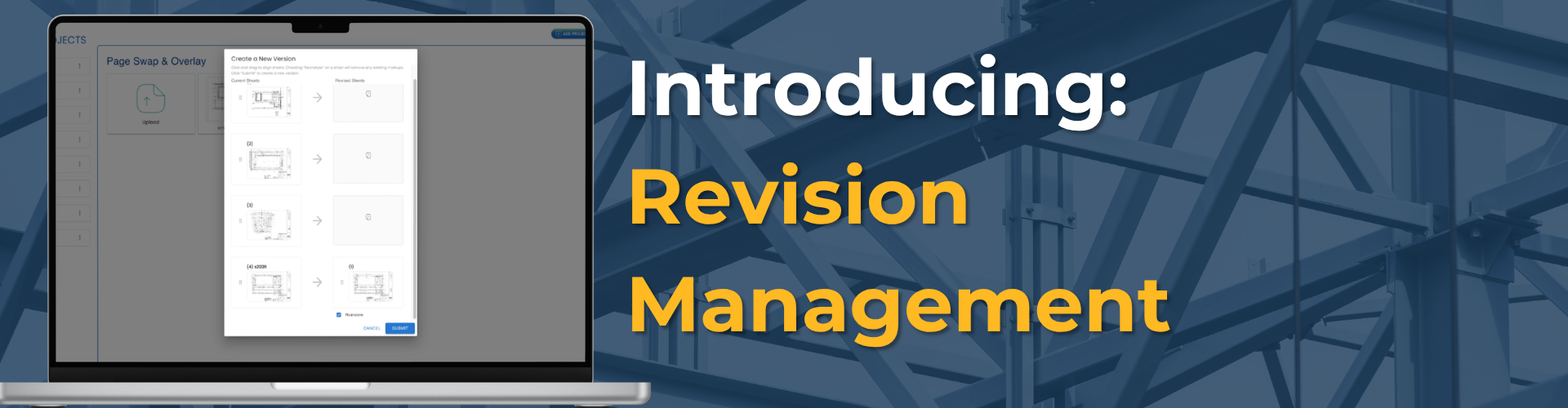
LIFT simplifies change management significantly. When you receive updated drawings, simply upload the revised pages to replace the old versions.

The software includes an overlay feature that displays old and new drawings side by side. You can quickly identify what changed, understand the impact on your quantities, and update your takeoff accordingly.

This revision handling saves tremendous time during the bidding process. Instead of scrambling to rework your entire estimate when changes arrive, you can assess the impact and adjust your numbers in minutes.

Real-World Impact: What LIFT Users Experience

The benefits of AI-powered takeoff software extend beyond just speed. Steel fabricators using LIFT report multiple improvements to their estimating process:

Increased Bidding Capacity: Estimators complete takeoffs in a fraction of the time, allowing teams to pursue more opportunities without adding staff. Some LIFT users report completing 40% more bids with the same team size.

Improved Accuracy: LIFT detects steel on most drawings with 95-99% accuracy. Automated counting reduces the human errors that lead to costly bid mistakes.

Better Resource Allocation: With tedious counting work automated, estimators can focus on higher-value activities like connection optimization, value engineering, and building customer relationships.

Faster Response Times: Complete takeoffs in minutes instead of hours or days, allowing you to submit competitive bids faster and pursue last-minute opportunities.

AI Takeoff Software for Structural Steel Fabricators

The construction industry is increasingly adopting artificial intelligence to solve longstanding productivity challenges. For structural steel estimators, AI takeoff software like LIFT represents a significant leap forward from manual methods.

By automating material detection, connection analysis, and data organization, AI eliminates the repetitive work that consumes most of an estimator's time. The technology handles tasks that computers do better than humans while freeing people to focus on the judgment and expertise that truly require human intelligence.

For fabricators looking to stay competitive, the question isn't whether to adopt AI-powered estimating tools, but how quickly you can integrate them into your workflow.

Getting Started with LIFT

Seeing LIFT work with your actual project drawings is the best way to understand its capabilities. The SketchDeck.ai team offers personalized demos where they analyze one of your own drawings and provide a free project in LIFT.

This hands-on approach lets you evaluate the software's accuracy with your specific drawing types, understand how it fits your workflow, and see exactly how much time it could save your team.

Ready to transform your steel takeoff process?

Book a free demo today.

How Steel Estimators Handle Complex Projects Without Burning Out: 5 Workflow Strategies That Cut Takeoff Time by 80%

Leading steel fabrication companies across the US however have discovered a different approach using AI construction estimating software. They're completing takeoffs in hours instead of days while maintaining 95-99% accuracy rates.

Here's how they're leveraging AI for construction estimating - and how you can transform your own steel takeoff workflows.

Strategy 1: Automate Steel Detection Instead of Manual Counting

The Old Way: Spending hours manually counting beams, columns, and braces and identifying connection types across hundreds of drawing pages.

The New Way: AI takeoff software that identifies structural steel elements in seconds, not hours.

Smart estimators have stopped taking off steel by hand. Instead, they're using AI construction estimator workflows that automatically detect, categorize, and count structural steel pieces across entire project sets.

This AI estimating software approach reduces typical takeoff time by 50-80% on beam-heavy projects. One estimator recently completed a 6,000-ton project takeoff that would have taken three days manually - finished in just six hours with automated detection.

The accuracy improvements are just as impressive. Manual counting introduces human error, especially on large projects. Automated detection maintains consistent accuracy rates above 95% even on complex drawings.

Strategy 2: Capture Beam Attributes Automatically, Not Manually

The Old Way: Manually recording every beam size, shape, stud count, and camber specification from drawing labels.

The New Way: AI construction estimating software that pulls shape, size, stud counts, and camber data directly from drawings.

This is where takeoff software workflows get really powerful. Instead of transcribing hundreds of beam specifications by hand, AI estimating software captures this information systematically, and depending on the tool you use, the software can provide great visibility and functionality to easily review these detections across entire project sets.

Teams using AI construction estimator tools for automated attribute capture report 60-75% time savings on specification-heavy projects. The manual transcription work that used to take a full day now happens in minutes.

This strategy also eliminates transcription errors that can cost thousands in material miscalculations. When beam attributes are captured automatically, your takeoffs become both faster and more reliable.

Strategy 3: Generate Bills of Materials Instantly, Not Over Hours

The Old Way: Manually creating BOMs by compiling and organizing all counted materials into spreadsheets.

The New Way: AI takeoff software with one-click BOM generation that automatically organizes all detected materials into professional project documentation.

Manual BOMs create administrative work. It adds no analytical value but consumes hours of estimator time. Progressive teams using AI for construction estimating have eliminated this bottleneck entirely.

Automated BOMs generation turns a 2-3 hour manual process into a 30-second task. This time savings accumulates quickly across multiple bids, effectively increasing your bidding capacity without adding staff.

The consistency benefits are significant too. Manual BOMs vary in format and completeness between estimators. Automated generation ensures every project gets the same professional, comprehensive documentation.

Advanced AI takeoff software also maintains complete traceability between your BOM and the original drawings. The software creates direct links and references to detected elements, prints Element IDs on PDF exports, and includes these IDs in CSV files. This traceability means you can instantly track any BOM item back to its exact location on the drawings, dramatically reducing the chance of errors or missing material during project execution.

Strategy 4: Analyze Connection Details Automatically, Not Manually

The Old Way: Manually reviewing every framing condition, moment connection, cope, and hole detail across project drawings.

The New Way: AI construction estimating software with automated connection analysis that identifies and catalogs framing conditions, moments, copes, and holes systematically.

Connection analysis is where experienced estimators add the most value, but it's also where they spend too much time on routine takeoff work.

Advanced takeoff software now handles the routine connection identification automatically, freeing estimators to focus on complex engineering decisions and pricing strategies.

Teams report 40-60% time savings on connection-heavy projects when routine analysis is automated. This lets senior estimators focus on the specialized work that truly requires their expertise.

Strategy 5: Export to Your Tools Seamlessly, Not Through Manual Data Entry

The Old Way: Manually re-entering takeoff data into Tekla, Strumis, EJE, or Excel for further project development.

The New Way: Direct export capabilities that move project data into your existing tools without manual re-entry.

Data re-entry is where projects bog down and errors multiply. Every manual transfer introduces opportunities for mistakes and consumes valuable estimator time.

Seamless export capabilities eliminate 3-5 hours of manual data entry per project. More importantly, they maintain data integrity throughout your entire project workflow.

Whether you're working in Tekla, Strumis, or other fabrication software, direct export means your takeoff work flows smoothly into downstream processes without bottlenecks.

Advanced Strategy: Handle Large Document Sets Like a Pro

Complex steel projects often involve 200-500 pages of structural drawings. Manual processing means days of work before you even begin the real estimation analysis.

Leading estimators using AI construction estimator tools now process even massive document sets in hours, not days. They upload entire project sets and let AI estimating software handle the routine detection work across all drawings simultaneously.

This approach transforms how you handle large industrial projects, multi-story buildings, and complex fabrication work. Instead of dreading big projects, you can bid on them confidently knowing your workflows can handle the volume.

The Results Speak for Themselves

Steel fabrication companies implementing these workflow strategies are seeing dramatic improvements:

The pattern is clear: AI for construction estimating handles routine work, estimators focus on expertise, and companies win more profitable projects.

Why This Matters Now

The steel fabrication industry is facing unprecedented challenges. Labor shortages, tight project timelines, and increasing competition mean you can't afford inefficient takeoff processes.

Companies that adopt AI construction estimating software gain competitive advantages that compound over time. They bid on more projects, win more contracts, and grow faster than competitors stuck with manual processes.

Meanwhile, estimators working with optimized workflows report higher job satisfaction and less burnout. When technology handles the tedious work, professionals can focus on the analytical and strategic work they actually enjoy.

The Bottom Line

Complex steel projects don't have to mean 60-hour work weeks and stressed-out estimators. The solution is building workflows that automate routine detection and analysis while preserving human expertise for high-value decisions.

Teams implementing these strategies typically see 50-80% reductions in takeoff time within the first month. The learning curve is minimal, but the productivity gains are immediate and substantial.

The steel industry is evolving rapidly. Fabrication companies that embrace workflow automation will dominate their markets. Those that don't will struggle to compete on speed, accuracy, and bidding capacity.

Your estimators deserve workflows that amplify their expertise instead of burying them in manual counting work.

Ready to Transform Your Steel Takeoff Process?

These strategies represent how leading steel fabrication companies are staying competitive in 2025. The question isn't whether workflow automation works - the results prove it does.

The question is how quickly you can implement these improvements in your own takeoff processes.

Start by identifying which manual processes consume the most estimator time in your current workflow. That's where automation will deliver the biggest immediate impact.

Remember: your competitors are already implementing these strategies. The companies that move first will capture the biggest competitive advantages.

Which of these workflow bottlenecks is costing your team the most time right now? How many more bids could you complete with 50-80% faster takeoffs?

Why the Steel Industry Is Turning to AI: The Complete Guide to Construction Automation

You're Running a Steel Fabrication Business in the Most Challenging Market in Years

Every morning, you face the same reality: your estimating team is stretched thin, qualified estimators are harder to find than ever, and every bid opportunity has become precious. With construction down 13% and $1 trillion in private funding sitting on the sidelines, the pressure to win work has never been higher.

Your team is talented, but they're spending days on manual takeoffs that should take hours. Meanwhile, competitors are responding faster to opportunities, and you're wondering how they're doing it.

If this sounds familiar, you're not alone. But some steel fabricators have discovered a way to not just survive – but thrive.

The Problems Keeping You Up at Night

Your Estimating Team Is Under Unprecedented Pressure

Cost estimator employment is projected to decline 4% from 2023 to 2033, with 18,000 annual openings primarily from retirements. Industry experts report that "estimators are becoming harder to find during the labor shortage." Your existing team is handling more work than ever, and finding qualified replacements is nearly impossible.

Market Conditions Are Working Against You

Private Funding Paralysis: U.S. private equity managers have more than $1 trillion in uninvested capital sitting on the sidelines due to political uncertainty and interest rate volatility.

Limited Opportunities: The majority of current work is publicly funded, but there's not enough public work for all the competition. Multiple companies are chasing the same limited projects, driving down margins.

Uncertain Recovery: Construction starts have slowed dramatically, and recovery depends on interest rates falling and private confidence returning – with no clear timeline.

Your Daily Operational Challenges

Time-Consuming Manual Takeoffs: Manual counting steel stretches hours into days. Troy Ernst, Chief Estimator at King Steel, describes their old process: "We had a 4-day manual process that was eating up our capacity."

Accuracy Under Pressure: Missing steel on estimates can be costly. The pressure to deliver accurate estimates quickly puts companies at risk of errors, especially with increasingly complex technical documentation.

There Is a Solution: How Leading Companies Are Solving This

You don't have to face these challenges alone. Steel fabricators across North America are discovering that AI-powered automation can transform their operations, and the approach is more accessible than most realize.

The breakthrough came when machine learning and AI technology advanced enough to accurately identify structural elements from 2D engineering drawings. This isn't theoretical – over $25 billion has been bid through AI-powered systems with 95-99% accuracy in steel detection.

How This Technology Works:

Your Strategic Approach: 4 Phases to Transformation

Phase 1: Validate the Technology

Start by seeing the technology work on your actual projects. The best way to understand the impact is to have your own drawings analyzed, not generic demonstrations.

Phase 2: Strategic Implementation

Begin with simple projects that offer the best learning opportunities. This builds team confidence while proving the technology's value on real work.

Phase 3: Team Development

Choose a champion or two and invest in developing your team's capabilities with the new technology. The goal is to amplify their expertise, not replace it.

Phase 4: Scale for Impact

Expand usage strategically across your estimating team. Most companies find they're comfortably using AI-powered tools on the majority of their projects within months of starting.

Success: What Victory Looks Like

King Steel Inc. - 50% Time Reduction

Troy Ernst, Chief Estimator: "It'd be awful not to have LIFT. We're relying on it now."

James Jones, Senior Estimator: "The beam counts are spectacular!"

Read the full King Steel case study →

Motion Steel - 40-50% Daily Capacity Freed

Jay Livesay, General Manager: "With LIFT, we freed up 40 to 50% of our guys time on a daily basis."

See more Motion Steel results →

SSE Steel Fabrication - 50-75% Time Reduction

Justin Airhart, Chief Operating Officer: "Using LIFT has been an enjoyable experience. It cuts my time by 50 to 75 percent when doing an estimate. It's been awesome to work with it."

Results:

See how SSE achieved dramatic time savings →

FabArc Steel - Days to Minutes

Nathan Whitley, Chief Estimator: "What used to take two days to do, it does it within a few minutes. I've been amazed at every step of the process."

Learn about FabArc Steel's transformation →

Industry-Wide Validation

Mason Carragher, MSE Estimator: "It's the first software that is actually geared towards estimators in a meaningful way."

View all customer success stories →

The Strategic Advantages of AI Adoption

Solving the Workforce Challenge

The decline in estimator employment isn't just a hiring problem – it's a strategic challenge that forward-thinking companies are turning into a competitive advantage. When you can't find skilled estimators to hire, the solution becomes maximizing the productivity of the team you already have.

AI automation allows your existing estimators to handle significantly more work without the stress and errors that come from being overloaded. Instead of competing with other companies for scarce estimator talent, you're building capabilities that don't depend on the external labor market. This becomes especially valuable as experienced estimators retire, because the technology helps preserve and standardize their institutional knowledge rather than losing it.

The result? Your bidding capacity becomes independent of workforce availability, giving you a sustained competitive edge.

Thriving in Market Uncertainty

In volatile markets, consistency becomes your greatest asset. AI-powered processes deliver standardized results regardless of external conditions, whether you're dealing with political uncertainty, interest rate fluctuations, or shifting project types.

This consistency translates into practical advantages: faster response times to opportunities as they arise, the ability to handle workload fluctuations without scrambling to hire during busy periods, and reduced dependence on finding skilled estimators when you need to scale quickly.

While competitors struggle with capacity constraints and workforce limitations, your operations remain stable and responsive.

Maximizing Your Resources

The mathematics of AI adoption are compelling. When your estimators can complete more estimates in less time, you maintain competitive response times even when facing resource constraints. Senior estimators spend less time on manual counting and more time on strategic decision-making, client relationships, and complex problem-solving.

This resource optimization positions you perfectly for market recovery. When opportunities increase and private funding returns, you'll have established efficient processes ready to scale, rather than scrambling to build capacity when demand surges.

Understanding the Financial Impact

Immediate Operational Benefits

The productivity gains are measurable from day one. Takeoffs that previously required hours are completed in minutes, with remarkable accuracy rates that often exceed manual accuracy under time pressure. Your existing team's productivity increases dramatically without adding headcount, and streamlined workflows reduce the costly errors that can derail project profitability.

These aren't theoretical benefits – they're the documented results that companies like King Steel, Motion Steel, and MSE have achieved in real-world operations.

Long-Term Financial Returns

The financial advantages compound over time. You're maximizing productivity without the costs and delays of hiring additional estimators. There's no need to compete for scarce talent with higher salaries and benefits packages. Your increased bidding capacity creates more revenue opportunities, while faster, more accurate estimates strengthen client relationships and improve win rates.

Perhaps most importantly, you're building sustainable competitive advantages that don't depend on external factors like labor availability or market conditions. These capabilities become more valuable during downturns and position you to capture disproportionate value when markets recover.

Common Concerns Addressed

"Will AI Replace Our Estimators?" No. AI gives estimators superpowers, handling tedious tasks so they focus on strategic evaluation, client relationships, and complex problem-solving.

"What's the Cost?" ROI is typically realized within months through maximized team productivity, increased bidding capacity, and fewer costly errors.

"Can We Trust AI Accuracy?" Leading systems achieve 95-99% accuracy, often exceeding human accuracy under time pressure.

The Stakes: What Happens If You Don't Act

The steel industry is at a crossroads. With estimator employment declining 4% through 2033 and qualified estimators becoming harder to find, companies embracing AI now are establishing crucial advantages in bidding capacity, accuracy rates, and operational efficiency.

Companies that act now will:

Those that wait risk being left behind by competitors who can bid faster, more accurately, and handle more opportunities.

Your Next Step: Take Action Now

The transformation is happening now. Companies across North America are using AI to complete billions in bids, saving thousands of hours while competitors still count steel by hand.

As Troy Ernst from King Steel puts it: "It'd be awful not to have LIFT. We're relying on it now."

With documented estimator workforce challenges, market uncertainty, and the need for operational excellence, the companies that act now will establish competitive advantages that define the next decade.

Ready to transform your estimating process?

Book a demo and let us show you with your own blueprints exactly how LIFT works. We'll analyze one of your project drawings and provide a free project to see if it's a good fit for your company.

Don't let your competitors get ahead while you're still counting steel by hand.

Arrival of AI in Structural Steel

NOTE: This article was originally published in AISC's June Edition of Modern Steel Construction

ARTIFICIAL INTELLIGENCE (Al) has taken the world by storm, revolutionizing the way machines and computer systems think, learn, and perform tasks that were previously the exclusive domain of human intelligence. While some industry sectors have been reluctant to use Al and are skeptical of its impact, the steel industry is increasingly pushing past its initial hesitation and tackling age-old challenges with Al.

The construction and trade industries are plagued with significant issues in labor shortage, low productivity, volatile costs, and manual and repetitive workflows ripe for Al technology innovation. Al systems today can perform tasks like understanding human language, recognizing patterns, learning from experience, and making predictions and decisions. There is no better time than now for innovations that can be used to reduce wasted time and material, alleviate worker stress, and help our industries work safer and faster. Al is already impacting construction speed and quality, efficient material use, and will continue to impact the planning, designing, fabrication, and construction phases of projects.

Historical Context

To understand why Al is poised to have a transformative impact across industries, start from the earliest mentions of Al and the breakthroughs that led us to where we are today. In 1950, computer scientist Alan Turing introduced the "Turing Test" —also called the "Imitation Game"-in his paper, Computer and Machine Intelligence. The Turing Test measures a machine's intelligence by having a human evaluator interact with a machine and a human, without knowing which is which, and judge the machine's success based on whether it can convincingly mimic human behavior.

Five years later, scientist and professor John McCarthy, known as the father of Al, held a conference at Dartmouth College and coined the phrase "Artificial Intelligence." Throughout the next two decades, scientists advanced Al technologies and some companies began using them to support human workers.

After decades of incremental research progress and exponential growth in available computing power, Al can now replicate human performance on a wide range of tasks. In recent examples, Al systems have passed the multiple choice and written portions of the bar exam and the highly competitive Fundamentals of Engineering Environmental Exam.

Since late 2021, public awareness of Al has exploded with advances in Generative Al, a subset of Al that can generate new content, such as images, text, audio, or video, similar to or indistinguishable from real examples. These systems use vast amounts of data collected from the Internet to allow the models to learn patterns. The most well-known generative Al tool today is Chat- GPT, which can generate human-like responses to text prompts. Generative Al tools can paint pictures, write poetry, develop archi- tectural designs, and establish proposals independently.

Common Types of Al and Their Applications

A single Al system has yet to match or exceed human-level intelligence across a wide range of cognitive tasks, a benchmark referred to as artificial general intelligence (AGI). Instead, existing Al applications are limited to narrowly defined ones that mimic human performance on specific tasks-referred to as narrow Al.

Today's most popular Al systems leverage vast amounts of data using neural networks, a mathematical structure inspired by the biological neural networks found in the brain, to uncover patterns, learn, and make predictions from available data. These neural networks and the architectures developed around them have led to significant advancements in computer vision and natural language processing-two subsets of narrow Al—as well as other areas. Project owners, engineers, architects, fabricators, and contractors have leveraged the advancements to work faster and more accurately.

Computer vision is a powerful technology used to interpret and understand the visual world. Within construction, computer vision algorithms are used to monitor construction progress and identify safety risks faster and often more accurately than a human can. One exciting application of computer vision allows fabricators to scan construction bidding plans and output material takeoffs.

For example, King Steel, an AISC member fabricator in Lawrenceville, Ga., is one of many fabricators using SketchDeckai's program "LIFT" to cut their material takeoff times by 50%, giving them two extra days per week to focus on higher-value tasks.

Natural language processing (NLP) is an Al technique embedded in popular applications like virtual assistants or chatbots. It allows computers to understand, interpret, and generate text and speech in a way that is understandable to humans. The steel industry and other construction contractors can use custom built NLP models and tools to scan contracts to identify risks, scope, and missing components ahead of time.

Many NLP applications function as virtual assistants, researchers, and consultants to help ensure consistent quality and considerations within contracts. When thinking about where NLP might be useful in your organization, consider where you could use an assistant to read documents and answer questions or write reports based on their reading.

In addition to working with images and text, Al can analyze a wide range of structured and unstructured data sources that can be used at all stages of a construction project.

In the design and planning processes, Al systems could analyze enormous amounts of data from past projects, material properties, and environmental factors to support the design of efficient and cost-effective steel structures. Some engineers and designers are using these systems to create internal search engines for their technical data sets, and others have attempted to use these tools to provide a cold start during design, proposal writing, contract creation, and review that saves valuable time.

Predictive maintenance and quality control are other vital areas where Al can impact the construction industry by monitoring steel structures and collecting data in real time from various cameras, sensors, and devices. Al algorithms can take the data and detect potential issues, such as corrosion, fatigue, and structural weakness, before they cause damage or harm. Proactive and predictive maintenance reduces downtime and ensures the safety and durability of steel structures.

Similar technologies to those that monitor structures can also predict equipment failures before they happen. By monitoring machinery and equipment operational conditions, typically with sensors and data analytics software, Al can identify patterns that could indicate a potential breakdown or significant wear, providing consistent quality during production and increasing safety.

Work previously done by an individual can now be completed with Al's help and reduce the time and effort required in design, planning, and construction phases. Streamlined processes will benefit owners, designers, fabricators, and contractors when dealing with changing information during design and construction and while processing numerous data points in complicated projects.

Considerations for Al Implementation

Al's opportunities are endless, but it is not yet infallible. Creativity and speed can at times come at the cost of accuracy. In some cases, Al systems can hallucinate, making connections in the data where none exist. A generative Al tool used to describe an image or summarize a document may add details that aren't present in the image or in the document itself.

Those glitches have made companies and workers ask if they can trust Al. Will it be accurate enough? Is company data private and safe? Are teams and staff prepared for the impact it will have? How and where should companies start implementation?

In high-stakes applications where errors could have severe financial, societal, or safety consequences, using systems and designing workflows that incorporate human oversight and intervention can mitigate risks and ensure safety. While Al can often outperform humans in narrow tasks with great accuracy, the more complicated a decision-making process becomes, the higher the likelihood for Al errors. A human-in-the-loop approach is essential to building trust within an organization and mitigating the impact of errors that are inherent in probabilistic systems.

Successful Al implementation often requires identifying individuals within an organization who are enthusiastic about Al and willing to champion its adoption. They should be advocates, educators, and role models for others, helping to promote a culture of innovation and learning. Companies should empower these Al champions or specialists to lead Al initiatives, share knowledge, and drive organizational change.

It's also important to invest in skills development and upskilling for your teams to gain the knowledge and expertise required to work effectively with Al. Many Al tools and educational options are available for free to the public.

For those not sure where to start, think about your organization's most pressing challenges. Are your teams overwhelmed by the amount of work they process? Are you having difficulty managing your schedules, completing your designs promptly, or responding to customers? Using Al to tackle your most significant challenges will often lead to the highest impact on your organization. Despite a keen focus on your biggest problems, starting small and re-investing in technologies that show great promise is a sure way to win with Al.

Future Outlook

Many fabricators across the country using Al software are already seeing its benefits. SteelFab, Inc. vice president of preconstruction Jonathan Mertz and senior estimator Garrett Gallagher each attest to Al creating time savings that help the company minimize errors, bid on more work, focus on proposals, respond to customers faster, and improve the overall quality of bids. A novelty tool for them and others not long ago has quickly become an essential part of their work.

Similar stories are being told across multiple industries. As Al continues to revolutionize industries, its transformative power is clear: by harnessing its potential, companies can overcome labor shortages, reduce costs, and drive growth, ultimately gaining a competitive edge in a rapidly evolving landscape.