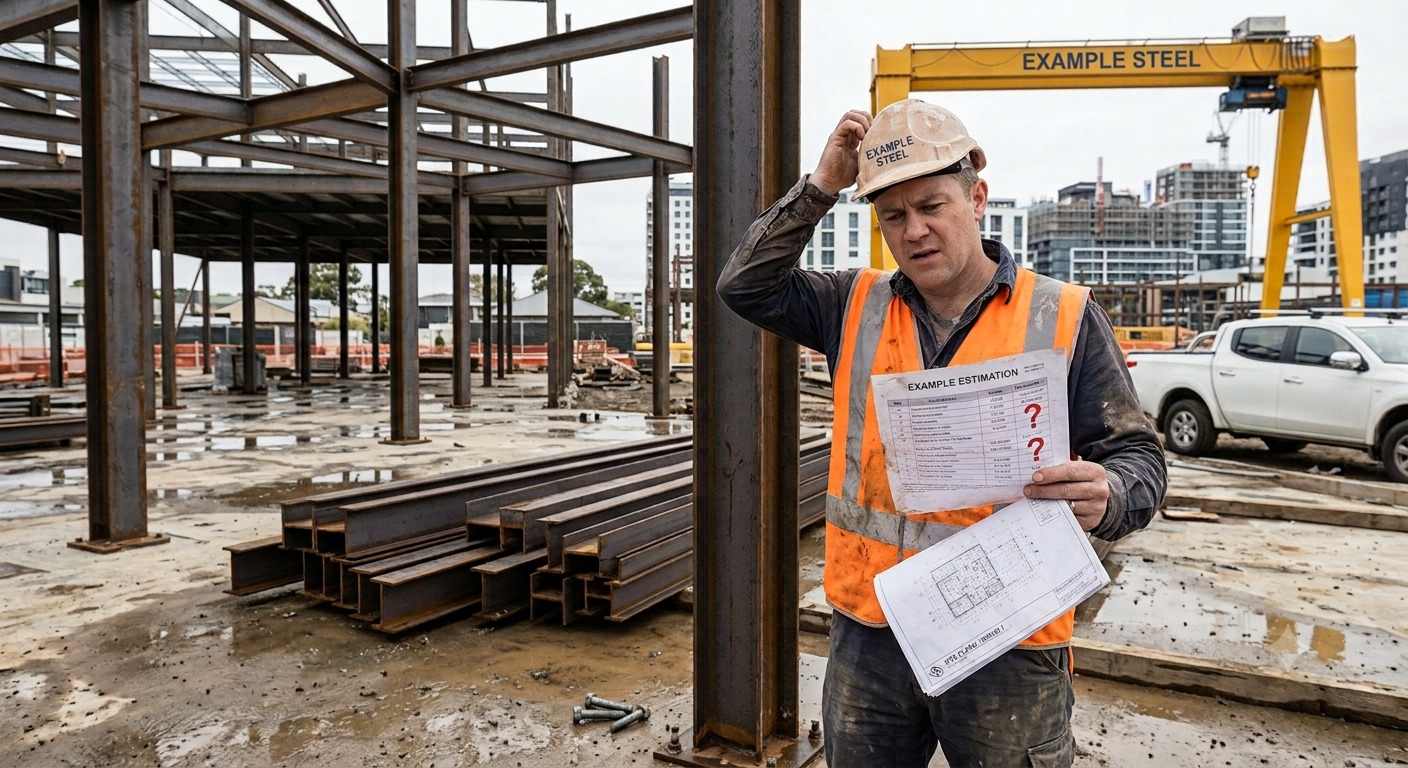

Incomplete drawings are one of the persistent realities of steel estimating. Missing dimensions. Vague connection callouts. Conflicting specifications between the drawing set and the specifications book. Notes that reference details that never made it into the drawing package. The estimator who has never dealt with an ambiguous bid set has never dealt with a real bid set.
The question is not whether ambiguities will show up. The question is what discipline the estimating department applies when they do. The shops that consistently win profitable work treat drawing ambiguities as a systematic risk to manage, not as a nuisance to work around. That distinction changes everything about how bids get priced, how RFIs get handled, and how much margin gets protected.
This article walks through the five most common types of drawing ambiguity, the four-step process for handling them systematically, and how modern AI tooling supports the discipline without replacing the estimator judgment that ambiguity fundamentally requires.
This article sits under Building a High-Performance Steel Estimating Workflow and is the ambiguity-management companion to the broader workflow design covered in the pillar.
The financial exposure of poorly-handled ambiguity is real. According to the Construction Industry Institute, rework represents between 2% and 20% of total project costs, with an average of 12%. Ambiguous drawings sit upstream in that chain. A vague connection detail that becomes an estimator assumption at bid time becomes a change order conversation during fabrication becomes either an absorbed margin loss or a contentious negotiation with the GC.
The CFMA Construction Financial Benchmarks Report shows industry net profit margins running around 5-6%, with specialty trades around 6.9%. At those margins, the estimator's approach to ambiguity is a first-order determinant of whether the bid stays profitable through fabrication.
The ANSI/AISC 303-22 Code of Standard Practice is the authoritative framework here. AISC 303 defines what constitutes complete structural steel contract documents and establishes the process for handling deviations from that standard. When drawings fall short of the AISC 303 baseline, that is a scope event the estimator needs to identify and address, not absorb.
Five recurring patterns produce most of the ambiguity that estimators encounter. Naming them explicitly is the first step in defending against them.
Beam lengths without clear endpoints. Connection spacing not specified. Base plate dimensions callouts that reference a schedule that does not exist in the drawing set. Column heights that require adding up dimensions across multiple sheets.
The risk is that the estimator either guesses or defaults to a standard assumption, both of which produce wrong material orders, field fit issues, and fabrication waste.
The structural schedule specifies A992 for beams. The general notes specify A36. The specifications book says A572 Grade 50. Three different documents, three different answers. Which one governs?
Per the AISC 303-22 hierarchy, the specifications typically govern over general notes, and the schedule typically governs over less-specific callouts. But when the three conflict, the estimator either has to interpret the conflict or issue an RFI. Guessing wrong drives either overpaying for material or using an incorrect grade that raises safety and code compliance concerns.
For the systematic classification framework that catches grade conflicts, see Material Classification Best Practices: Plates, Angles, Channels, and More.
"TYP. CONNECTION" callouts without weld symbols or bolt sizes. Detail bubbles that reference sheets not included in the drawing set. Moment connections shown schematically without dimensions. Framing connections that could be interpreted as either shear tabs or clip angles.
Connections drive a disproportionate share of fabrication labor cost. Underestimating the connection scope at takeoff, whether by assuming bolted when the drawing intends welded, or by missing stiffeners on a moment connection, is one of the most common margin-killing patterns in steel estimating.
For the systematic framework, see Connection Identification: A Systematic Approach.
Drawing A-501 Rev 2 supersedes Rev 1, but Rev 1 is in the bid set. Cross-references between sheets point to revised details that may or may not match the corresponding drawings. Change bubbles on some sheets but not others, making it unclear whether the changes propagated across the set.
The cost of working from an obsolete drawing is that fabricated pieces may not match the current design intent, which becomes rework or scrap after the shop drawings surface the mismatch. For the revision management framework, see LIFT-Delta: Introducing Revision Management and Did You Know: How to Process Revised Drawings Automatically in LIFT.
Fireproofing requirements mentioned in the specifications but not called out on structural drawings. AESS finishing requirements per AISC 303-22 without the specific AESS category identified. Galvanizing scope that appears in one drawing note but not in the specifications. Anchor bolts sized in the concrete drawings but not in the structural steel drawings.
The risk is that the estimator focuses on structural drawings and misses scope items documented elsewhere in the contract documents. This is one of the most common change-order sources on projects that otherwise looked complete at bid time.
The systematic approach below is what turns ambiguity management from ad hoc effort into a repeatable discipline.
Ambiguities should be flagged during the initial drawing review, not discovered mid-takeoff. Structured intake catches them at the cheapest point in the workflow.
For more on the drawing review discipline, see Steel Takeoff Checklist: What Every Estimator Should Verify.
RFIs work when they are structured, specific, and submitted early. Poorly-written RFIs get ignored, which pushes the estimator back into the guessing position.
For the RFI format that produces responses, see The Ideal Steel Estimating Workflow: From RFP to Bid Submission.
Documentation is what protects the bid when a scope dispute surfaces after submission.
This documentation discipline is what turns ambiguous bids into defensible ones. GCs and clients respect estimators who make their assumptions explicit far more than they respect estimators who bury them.
Technology cannot resolve ambiguity. Only the design team can do that. What technology can do is make the ambiguity intake and revision management faster and more systematic.
The specific things AI takeoff tools handle well:
The estimator judgment layer stays essential. AI does not decide whether A992 or A36 governs when the documents conflict. It does not interpret vague connection callouts. It does not draft the RFI. What it does is remove the high-volume detection work that was consuming the estimator hours those judgment calls actually require. For more on the partnership model, see What AI Can and Cannot Do in Steel Estimating: Setting Realistic Expectations.
The three-tier review discipline (self-review, peer review, management review) is where ambiguity-driven errors get caught before they reach the client. For the full QA/QC framework, see Double-Checking Your Work: QA/QC Workflows for Takeoffs.
The dynamic Maccabee estimator Dawn Hargraves described in her published case study applies directly to ambiguity management:
"I actually appreciate that it's not 100% perfect because it keeps me engaged and checking the work. We can catch any issues while still saving massive amounts of time."
MSE Chief Estimator Nathan Whitley captured the same principle in the MSE case study:
"What used to take an estimator two days to do, it does it within a few minutes. I've been amazed at every step of the process."
This is the partnership model the human-in-the-loop research literature consistently identifies as the highest-performing configuration. AI provides consistent baseline detection. Estimator review handles the ambiguity and judgment calls. Together they produce better outcomes than either approach alone.
Wondering whether your shop is ready to systematize ambiguity management? 5 Signs Your Steel Estimating Process Is Ready for an AI Transformation gives a quick gut-check.
The disciplines below turn ambiguity management from reactive firefighting into proactive risk management.
Build a clarity library. Save resolved ambiguities as institutional knowledge. When a specific ambiguity pattern surfaces on a project, the resolution goes into the library so the next estimator does not need to re-solve the same problem. Over years, this library becomes one of the most valuable assets in the estimating department.
Train the team on AISC drawing standards. Familiarity with AISC 303-22 conventions and the AISC Steel Construction Manual reduces the ambiguity rate at intake. Many "ambiguous" items are actually standard notations that unfamiliar estimators misread.
Set explicit tolerance thresholds. If more than a threshold percentage of items on a bid are ambiguous, that is a signal that the drawing package is not bid-ready. Flag it to management before absorbing the interpretation risk into the estimate.
Involve the fabricators. Shop fabricators often spot ambiguities that estimators miss because they see the drawings from a different perspective. Circulating drawings to the fab team during ambiguity review catches issues the estimator alone would not.
Bidding on guesses. Padding by 20% loses the bid to competitors who took the time to clarify. Padding by 5% still loses money on projects with meaningful ambiguity. Clarify first. If clarification is impossible in the timeframe, document the assumption explicitly.
Ignoring "minor" revisions. Every revision needs comparison, even ones flagged as minor by the design team. What looks minor in the drawings sometimes affects meaningful scope.
Working in silos. Estimator, fabricator, and PM should all see the drawing set. Different perspectives catch different ambiguities.
For the broader best practices framework, see The Essentials: 10 Steel Estimating Best Practices Every Estimator Should Use.
The pattern across LIFT customers is consistent. Shops that ran disciplined implementations captured accuracy improvements alongside time savings, which supports better ambiguity management by freeing estimator attention for judgment work.
The freed capacity is what enables the ambiguity discipline to work. Estimators who are not consumed by manual counting have the time to write structured RFIs, log assumptions explicitly, and run the peer review that catches ambiguity-driven errors before they reach the client.
Ambiguous drawings are inevitable. Guesswork is optional.
The shops that consistently protect margin on ambiguous bid sets are the ones that treat ambiguity as a systematic risk to manage: structured intake to flag issues, disciplined RFI process to clarify proactively, explicit documentation of every decision, and AI tooling that removes the counting work so estimator attention can focus on the judgment calls that ambiguity actually requires.
The framework compounds over years. The clarity library grows. The RFI patterns improve. Estimator judgment gets applied to fewer bids as the workflow catches more ambiguities at intake. The reputation for accurate bids on messy drawing sets becomes the competitive advantage that wins the bids competitors decline.
If you want to test what AI-assisted ambiguity management looks like on your projects, the simplest move is to run an upcoming bid through LIFT in parallel with your current process. Compare both the time investment and the ambiguity handling on your specific drawing sets. You can start by booking a live demo.