
Every takeoff contains errors. The question is never whether your estimator made mistakes — fatigue, time pressure, and the limits of human attention guarantee it. The question is whether you will catch the errors before they reach procurement, the shop floor, or the field. The shops that consistently win profitable bids treat quality control not as a final review step but as a disciplined workflow that catches errors at every stage.
This article walks through the QA and QC framework experienced estimators use to catch errors before they become costly. The principles apply whether you are running manual takeoffs in spreadsheets, digital PDF takeoffs, or AI-assisted takeoffs in LIFT. The technology changes the speed; the verification discipline stays the same.
This article sits under Building a High-Performance Steel Estimating Workflow and is the QA/QC companion to the broader workflow design covered in the pillar.
The financial exposure on uncaught errors is real. According to the Construction Industry Institute, rework represents between 2% and 20% of total project costs, with an average of 12%. PlanRadar's analysis of multiple rework studies puts current rework at 5-8% of total project cost. Not all rework traces to estimating errors, but takeoff sits at the front of the chain. A missed beam at the bid stage becomes a procurement surprise, becomes a shop floor delay, becomes either an absorbed margin loss or a contentious change order conversation.
The CFMA Construction Financial Benchmarks Report shows industry net profit margins running around 5-6%, with specialty trades at around 6.9%. At those margins, even a small percentage of uncaught errors can wipe out the profit on multiple bids. The math of QA/QC is straightforward: the hours invested in structured verification are dramatically cheaper than the cost of the errors they catch.
The systematic approach below is anchored in two pieces of research worth knowing. The NIST AI Risk Management Framework organizes any high-stakes workflow around four functions: Govern, Map, Measure, and Manage. The QA/QC structure in this article maps directly to that approach. The systematic review of human-in-the-loop AI published in MDPI Entropy identifies the specific dynamic that QA/QC structures must counteract: as accuracy expectations rise (whether from individual experience or AI tooling), error-detection effort tends to drop. Structured review process is what prevents that drift.
Most people use QA and QC interchangeably. They are not the same.
Quality Assurance (QA) = Prevention. QA stops errors before they happen. It is about having the right processes from the start: standard procedures for every takeoff, checklists that force verification, templates that ensure consistency, and training that builds competence.
Quality Control (QC) = Detection. QC catches errors after they happen but before they cause damage: systematic review of completed work, cross-checking against benchmarks, peer review by a second estimator, and final verification before submission.
You need both. QA reduces the error rate at the source. QC catches what slips through. Shops that only do QA produce takeoffs that look organized but still ship with mistakes. Shops that only do QC catch errors but burn estimator time on rework that prevention would have avoided.
Before building the workflow, know what you are defending against. These are the recurring failure modes that consume estimator time and erode margin.
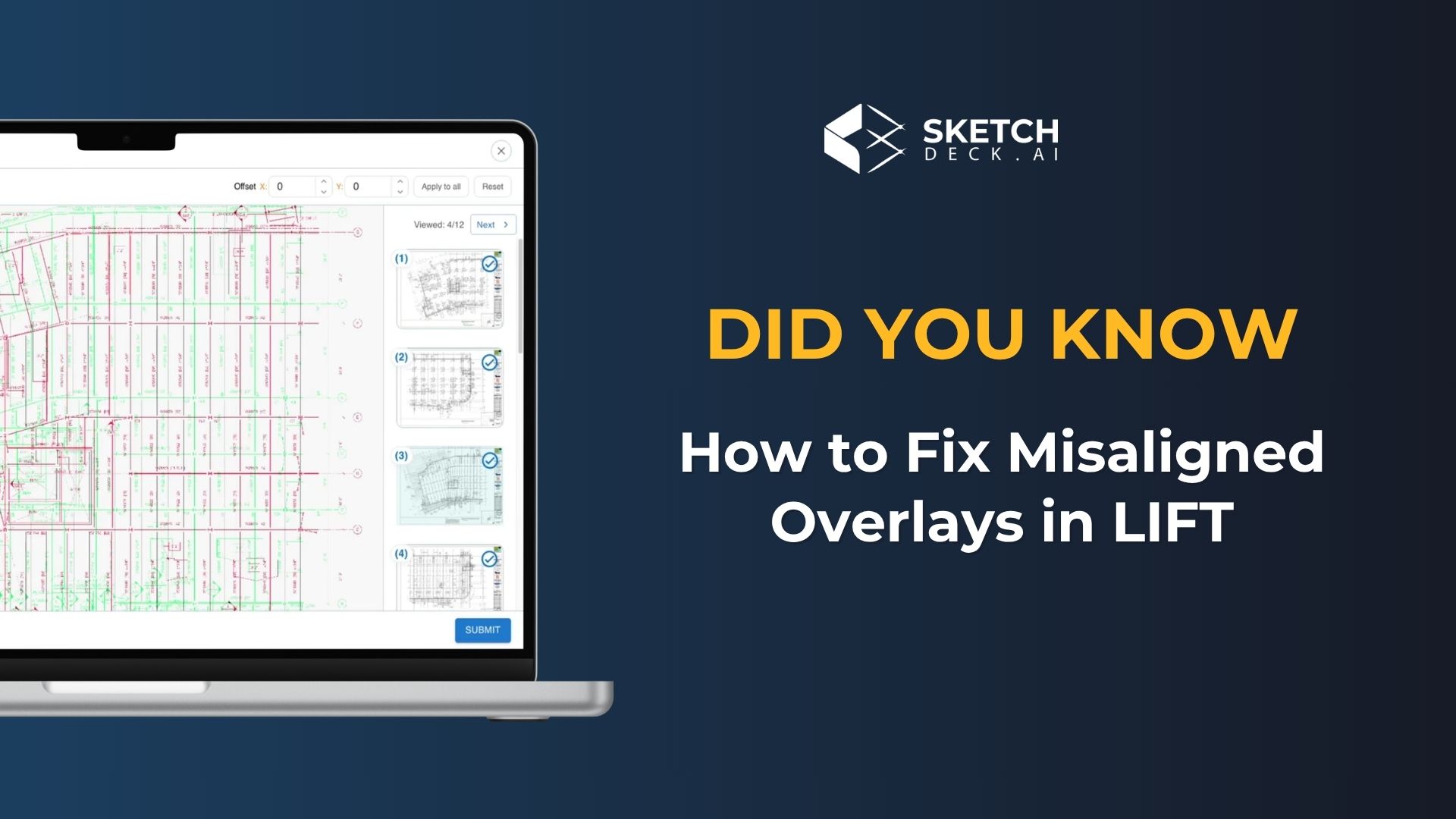
Wrong drawing version. Working from outdated drawings is one of the highest-impact errors because the entire takeoff has to be revisited once it is discovered. The fix is a structured version control protocol with timestamp verification at intake. For more on the mechanics, see LIFT-Delta: Introducing Revision Management.
Missed scope items. Stairs, railings, miscellaneous metals, and embed plates get rushed at the end of takeoff. They are scattered across the drawing set instead of concentrated on the framing plans, which makes them easy to undercount. The fix is a comprehensive scope checklist reviewed independently.
Quantity calculation errors. Math mistakes, wrong units, decimal point errors. Digital tools eliminate most of these, but they still happen during manual entry. The fix is automated calculations combined with manual spot-checks on outliers.
Material misclassification. Confusing W12x26 with W12x30, or A36 with A992 per the AISC and ASTM standards covered in the AISC Steel Construction Manual. Wrong material specifications can cause procurement delays and downstream rework. For more on the classification framework, see Material Classification Best Practices: Plates, Angles, Channels, and More.
Missing connections. Connections carry a disproportionate share of fabrication labor. Missing them at takeoff means significantly underpricing the bid. For the systematic approach to connection identification, see Connection Identification: A Systematic Approach.
Labor underestimation. Using wrong production rates or missing complexity factors. The fix is shop-specific historical data, tracked over projects and refined over time, not generic rules of thumb.
Overlooked site conditions. Access restrictions, weather windows, staging limitations. These can multiply field installation costs on complex sites. The fix is a mandatory site visit checklist with photo documentation.
Every one of these errors is preventable with proper QA/QC discipline applied consistently.
Quality Assurance starts before the first drawing opens. The discipline is about building prevention into every stage of the takeoff.
Every takeoff should follow the same sequence. Same process every time means fewer surprises.
Initial setup (about 30 minutes). Verify the project scope document. Confirm the drawing package is complete. Check drawing dates and revisions per the AISC Code of Standard Practice (303-22) framework that the contract documents assume by default. Set up the folder structure. Create the tracking spreadsheet.
Drawing review (about 1 hour). Page through the entire set first. Note missing information. Identify special conditions. Flag complex areas. Document assumptions in writing.
Systematic takeoff. Start with columns, then beams. Complete each floor before moving on. Use consistent color coding. Mark completed sections. Note questions as you go rather than after the fact.
Standardization prevents the random errors that come from variable approaches.
Checklists are the most underrated tool in steel estimating. They convert tacit knowledge into explicit, repeatable verification.
Pre-takeoff checklist:
During-takeoff checklist:
Post-takeoff checklist:
Print these. Use them. Every single time. For more on building this kind of QA discipline, see Steel Takeoff Checklist: What Every Estimator Should Verify.
Build mandatory stops into the workflow where verification must happen.
These stops catch errors early, when they are cheap to fix.
Quality Control is the safety net that catches what QA misses. The three-tier review below is what high-performing estimating departments run on every bid that matters.
Before anyone else sees the takeoff, the originating estimator reviews it. The single most important discipline here: step away first. Take a break. Fresh eyes catch what familiar eyes have stopped seeing.
Check the big picture:
Verify the details:
If anything feels wrong, it probably is. Investigate before passing to peer review.
The second set of eyes is critical. They catch what the originating estimator no longer sees after spending hours immersed in the drawings.
Choose the right reviewer:
Provide a complete package:
Review focus areas:
The reviewer should challenge everything. No assumptions. No "looks good to me." This is the dynamic Maccabee estimator Dawn Hargraves described in her published case study:
"I actually appreciate that it's not 100% perfect because it keeps me engaged and checking the work. We can catch any issues while still saving massive amounts of time."
That mindset is what makes peer review valuable. Reviewers who treat the process as a formality catch nothing. Reviewers who treat it as a structured investigation catch the items the originating estimator missed.
Final review by senior management focuses on business risk, not on counting errors.
Risk assessment questions:
Comparison checks:
Management review is about strategic decision-making, not catching arithmetic errors. The system works when each tier focuses on what only that tier can see.
For more on the broader QA discipline, see AI Errors and How to Catch Them: Quality Control Best Practices.
Wondering whether your team is ready to systematize this kind of review structure? 5 Signs Your Steel Estimating Process Is Ready for an AI Transformation gives a quick gut-check.
A QC process is only as good as its documentation. Three documents every estimating department should maintain.
A single document that travels with every takeoff:
Project information. Project name and number, estimator name, dates, drawing revision used, total hours spent.
Verification record. Self-review (date, name, issues found). Peer review (date, name, issues found). Management review (date, name, approval). Changes made and why. Final approval signature.
Assumption log. What you assumed and why. Missing information. Clarifications needed. RFI responses received. Impact on the estimate.
This document becomes your audit trail and your protection if scope disputes arise after the bid goes out.
Track every error found during QC. This becomes your improvement roadmap.
For each error, record:
Monthly analysis reveals the most common error types, which estimators may need additional training, which processes need refinement, and the ROI of your QC investment.
Build a reference library from completed projects. Track for each project:
The right benchmarks are your shop's historical data, not industry rules of thumb. A retail warehouse, a multi-story office, a hospital, and an industrial facility produce dramatically different ratios. Generic published ranges are too wide to be useful for sanity-checking a specific bid. Your benchmark library, accumulated over 50-100 projects, becomes more valuable than any published industry benchmark.
For more on this discipline, see The Essentials: 10 Steel Estimating Best Practices Every Estimator Should Use.
Manual QC works. Digital tools make it faster and more reliable.
Automated calculation checks. Spreadsheet formulas catch math errors instantly: sum verification across multiple sheets, automatic unit conversions, conditional formatting for outliers, error flags for impossible values. Build error checking into your templates.
Version control systems. Cloud storage with version history, automatic revision notifications, side-by-side comparison tools, change highlighting features. Never wonder if you have the latest drawings.
Collaborative review platforms. Modern tools enable remote peer review: screen sharing for live review, comment tracking, markup tools for drawings, approval workflows. The peer reviewer no longer needs to be in the same office.
AI takeoff tools change the speed and consistency of detection without replacing the estimator judgment that QA/QC depends on.
LIFT applies the same logic on every project, eliminating the variability that comes from estimator-to-estimator differences in methodology. The AI handles initial member detection, quantity calculations, material classification per AISC conventions, and connection identification. Standardization is built in.
The detection accuracy on most LIFT projects lands in the 95-99% range per SketchDeck product documentation, which means estimators start from a high-quality baseline and focus their QA discipline on the items that actually need judgment.
LIFT generates a BOM with traceability back to the exact drawing location for every line item. This makes peer review faster and more focused. Instead of re-counting from scratch, the reviewer clicks from a suspicious BOM row to the drawing and verifies in seconds.
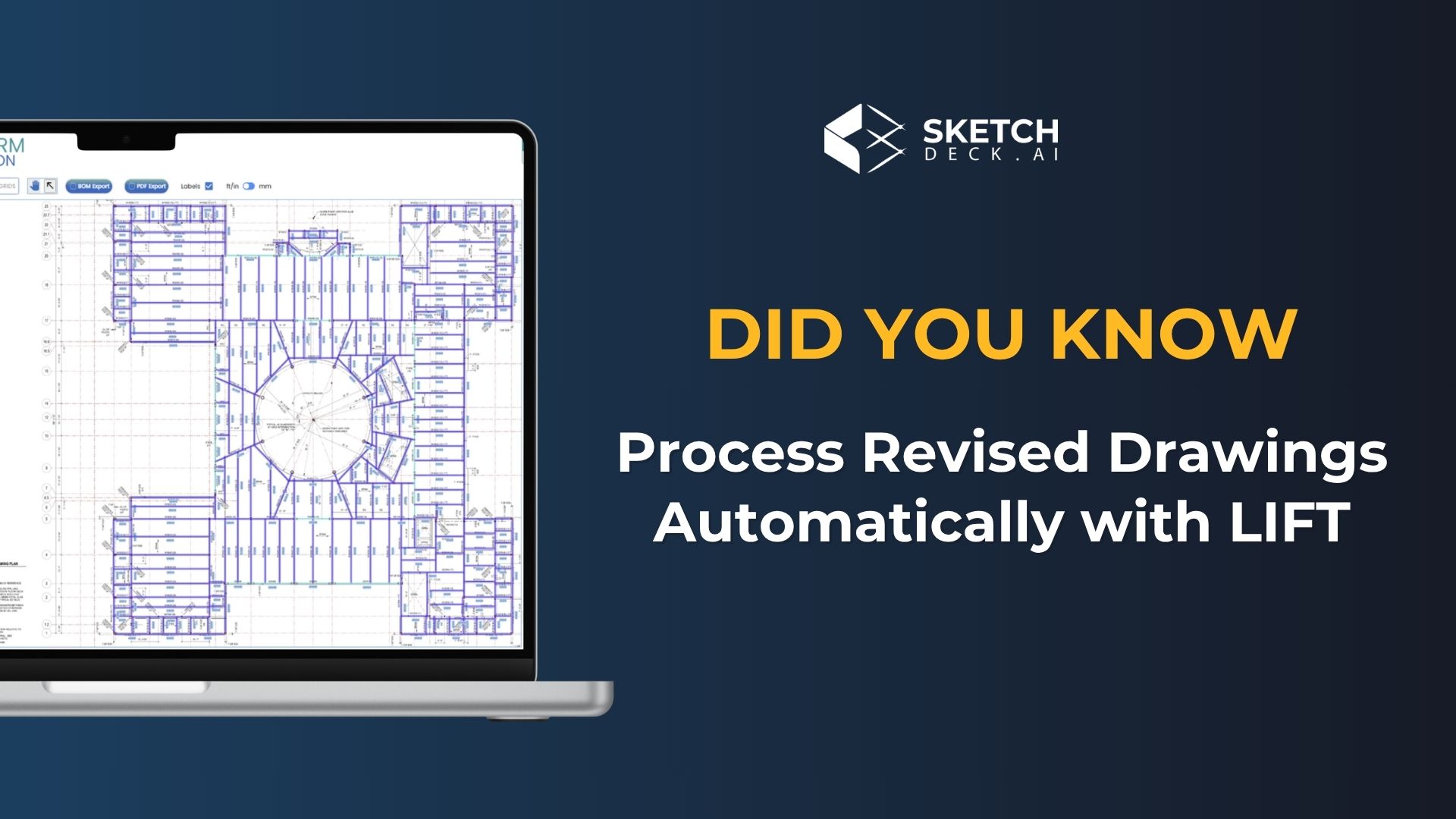
LIFT-Delta handles the version control problem by showing exactly what changed between drawing revisions. The "wrong drawing version" error category — historically one of the highest-cost QC failures — becomes much harder to make.
AI does not replace the three-tier review process. It changes what each tier focuses on.
The AI handles the high-volume repetitive verification. The estimators handle the judgment-intensive review. Together, the partnership produces more accurate takeoffs in less time than either approach alone — which matches the broader finding of the human-in-the-loop research literature.
The pattern across LIFT customers is consistent: AI handles the verification work that previously consumed estimator hours, freeing time for the strategic review that drives bid quality.
QA/QC is as much about mindset as process.
Creating a quality culture:
Overcoming resistance:
Quality is not about perfection. It is about continuous improvement and disciplined process. For more on the broader change management dynamic, see Change Management for AI in Steel Estimating: How to Bring Your Team Along.
A 30-day plan to upgrade your QA/QC.
Week 1: Assessment. Document current error rates. Identify common mistake patterns. Survey team challenges with the current process. Baseline where you are.
Week 2: Design. Create standard checklists. Build review templates. Define review responsibilities at each tier. Set verification points in the workflow.
Week 3: Training. Train the team on the new process. Practice peer reviews. Test the documentation system. Refine procedures based on team feedback.
Week 4: Implementation. Start on smaller projects to build the discipline. Track all errors found. Measure the time investment. Document what is working.
Ongoing optimization. Monthly error analysis. Quarterly process review. Continuous training as people join the team. Technology upgrades when they support the QC discipline rather than complicating it.
Track these metrics to verify your QA/QC system is working.
Error metrics. Errors caught in QC (should increase initially as the process catches what was previously missed, then decrease as QA prevents them). Errors reaching clients (should decrease rapidly). Cost impact of errors (should drop significantly). Error types (should shift from basic to complex over time).
Efficiency metrics. Time spent on QC as a percentage of takeoff time. Rework hours (should approach zero). Bid win rate. Profit margins on bid jobs.
Quality metrics. Client satisfaction. Repeat business rate. Bid accuracy variance against actuals. Team confidence at submission time.
If these metrics are not improving over a 60-90 day window, the process needs adjustment.
Every takeoff submitted without proper QA/QC is a gamble. The math of error cost versus QC investment is clear: structured verification is dramatically cheaper than the errors it catches. Industry research on construction rework consistently shows it represents a meaningful share of project cost, and takeoff errors sit at the front of that chain.
The framework is straightforward: separate QA (prevention) from QC (detection), apply standardized process and verification points throughout the takeoff, run three tiers of review on every bid that matters, document everything, build your shop's benchmark library, and use AI tools to handle the high-volume repetitive verification so estimator expertise focuses on the items that need judgment.
The shops winning consistently are the ones that have made this systematic. If you want to test what AI-assisted QA/QC looks like on your projects, run an upcoming bid through LIFT in parallel with your current process and compare both the time investment and the error catch rate. You can start by booking a live demo.