

For fabricators running tight operations while competitors make strategic bets on technology, geography, and capabilities, the question is not whether to adapt but how quickly you can position for the shifts already underway. This radar scans the market, technology, regulatory, workforce, and competitive forces reshaping steel fabrication in 2025 and beyond, filtering signal from noise so you can make informed strategic decisions.
Understanding the Forces Reshaping Steel Fabrication
Steel fabrication was predictable for decades. You knew your customers, your competitors, and your processes. That stability is ending, and multiple forces are converging:
Construction spending reached $2.16 trillion in 2024, representing 6.6% growth, though projections for 2025 moderate to $2.23 trillion with 3.3% growth as interest rate impacts and policy uncertainty temper the market. Aggregate numbers hide important sector divergence. Industrial construction, data centers, and infrastructure remain strong while office and retail construction face headwinds.
Technology adoption has accelerated dramatically. 37% of construction businesses now use AI and machine learning, up from 26% just two years ago. Digital integration, Building Information Modeling (BIM), and construction robotics are reaching maturity thresholds where competitive disadvantage accrues to those who lag. The steel industry is increasingly turning to AI as one way to help improve efficiency and tackle problems.
Labor dynamics are forcing operational changes. The construction industry must attract an estimated 439,000 net new workers in 2025 and nearly 500,000 in 2026 just to meet demand, but skilled trades and estimator roles remain critically understaffed. When your lead estimator is approaching retirement and you have no succession plan, that two-to-five-year training timeline becomes a business continuity crisis.
Regulatory complexity is growing: AISC code updates, sustainability and ESG requirements, trade policy uncertainty, and safety standards all demand attention and resources. Competitive dynamics are shifting as nationals expand, private equity consolidates regional players, and technology-enabled shops compete on speed and price.
Evaluating Which Trends Matter
Not every industry development deserves strategic attention. This article applies a consistent framework to each trend:
Impact: How much could this affect your revenue, costs, competitive position, or operational capability?
Timeline: When will this matter? Immediate threats require different responses than three-to-five-year horizons.
Certainty: How confident are we this will happen? Demographic shifts and allocated infrastructure funding have high certainty. Disruptive business models have lower certainty.
Actionability: What can and should fabricators do? Trends you can influence or respond to matter more than macro forces beyond your control.
Part 1: Market Trends
Trend 1.1: Infrastructure Spending Surge
Current State: The Infrastructure Investment and Jobs Act allocated $550 billion for infrastructure projects over five years, focused on bridges, transportation, water systems, broadband, and grid modernization. The American Institute of Steel Construction (AISC) estimates that for every $100 billion of new infrastructure investment, domestic steel demand could increase by as much as 5 million tons.
State and local matching funds amplify the impact. The rollout is slow, as typical for infrastructure, but spending is sustained over a decade or longer. This represents predictable, long-term demand concentrated in project types many commercial fabricators are less familiar with.
Why It Matters: Infrastructure projects involve public bidding requirements, often require specific bonding and certifications, follow longer timelines with different payment terms, and require relationships with infrastructure-focused general contractors and engineering firms.
Strategic Questions:
Is your shop positioned for infrastructure work? Do you have the bonding capacity, Buy America compliance capabilities, and public bidding experience? Are you building relationships with state DOTs and infrastructure-focused GCs? Can your estimating capacity handle the bid volume and documentation requirements of public projects?
Timeline: Current through 2030+
Certainty: Very high (funding allocated, spending underway)
Action Priority: High for shops not currently positioned in infrastructure
Trend 1.2: Regional Market Divergence
Hot markets in 2025 and 2026 include Texas (Austin, Dallas, Houston) for commercial and industrial work, the Southeast (Atlanta, Charlotte, Nashville) for distribution centers and data centers, the Southwest (Phoenix, Las Vegas) for industrial construction, and the Mountain West (Denver, Salt Lake City) for balanced mixed-use development.
Cooling markets include some coastal metros with high costs and permitting delays, Rust Belt commercial markets (though industrial is seeing resurgence), and markets with overbuilding in office and retail.
Why It Matters: Pricing power varies dramatically by region. Competition intensity differs, affecting both win rates and margins. Material sourcing, labor availability, and logistics also vary regionally.
Strategic Questions:
Is your local market growing or contracting? Are adjacent markets worth expansion consideration? Should you consider remote bidding in hot markets if local demand softens?
Timeline: Current through 2026
Certainty: High short-term, moderate long-term
Action Priority: High if considering geographic expansion
Trend 1.3: Construction Sector Mix Shift
Current State: Construction spending by sector is diverging. The 2026 construction outlook shows data centers ruling the market, while weaker sectors seek foothold. Industrial and warehouse construction remains strong. Data centers are experiencing explosive growth fueled by AI compute demands. Office construction is weak. Multi-family is strong but rate-sensitive. Healthcare remains steady.
Sector outlook for 2025 to 2026 based on industry forecasts.
Strong growth: Data centers, industrial distribution, healthcare infrastructure
Moderate growth: Multi-family, select retail, hotels
Weak: Office (especially suburban), traditional retail
Why It Matters: Sector concentration creates risk. Different sectors have different steel requirements and pricing power. Data centers, with their compressed schedules and performance requirements, often pay premiums for speed and reliability. If your revenue is heavily dependent on office construction, that exposure is a strategic vulnerability.
Strategic Questions:
What is your revenue mix by sector? Are you too concentrated? Are you positioned for growing sectors? Do you have the capabilities those sectors value (fast-track delivery, complex systems)?
Timeline: Current through 2026+
Certainty: High (shifts already underway)
Action Priority: Medium (inform bidding strategy)
Trend 1.4: Steel Pricing Volatility
After wild volatility from 2020 to 2022, prices normalized in 2023 but at a higher baseline. Moderate volatility continues with ongoing geopolitical and trade policy uncertainty.
Why It Matters: Pricing risk in long-lead projects can eliminate margins if steel costs spike after you lock in a bid. Material procurement strategy directly impacts profitability. Escalation clauses are becoming necessary.
Strategic Questions:
How are you managing material price risk? Are you using escalation clauses? Should you buy steel earlier to lock in prices? Can you pass through price increases? Are you tracking forward pricing indicators?
Timeline: Ongoing
Certainty: Very high (volatility is structural)
Action Priority: High (direct profit impact)
Part 2: Technology Trends
Across the structural steel industry, we hear a lot about labor shortages and scheduling constraints, all while the documentation associated with jobs are declining in quality. On top of this, we’re dealing with pricing fluctuations. Technology adoption is accelerating as a response. 37% of construction businesses now use AI and machine learning, up from 26% previously. Each additional technology adopted is associated with a 1.14% increase in expected revenue.
Trend 2.1: AI in Estimating
Current State: AI takeoff tools are production-ready and delivering measurable results. The steel industry is at a crossroads. With increasing competition, tighter timelines, and ever-growing demands for quality and efficiency, companies must evolve to keep pace. Those who don’t adopt new technologies will be replaced by those who do.
AISC’s Need for Speed Initiative committed the industry to increasing the speed of designing, fabricating, and erecting steel buildings by 50% by 2025. That target has arrived, and project teams can now design, fabricate, and erect steel frames 50% faster than in 2019 because of speed-related improvements at every step.
For estimating specifically, AI addresses the most time-consuming bottleneck: quantity extraction from drawings, which typically consumes 40% to 50% of total estimating time. SketchDeck, the first solution for structural steel takeoffs that uses machine learning technology to identify structural elements automatically from 2D engineering drawings, is helping fabricators complete tasks in minutes that used to take hours.
King Steel halved their estimation time, transforming a four-day manual process into a two-day automated one. Ennis Steel nearly doubled their bid output. “With [SketchDeck], we’ve almost doubled our bid output. We have an unlimited plan that lets all our in-house estimators produce an extra bid every week and a half, effectively doubling our output,” said Carlos Castillo, Director of Estimating at Ennis Steel Industries.
Why It Matters: Manual counting steel is time-consuming. Limited time for more bids stops you from winning more work. You cannot bid what you do not have time to estimate. Hiring experienced estimators is nearly impossible in the current labor market. AI multiplies your existing team’s output without the two-to-five-year training timeline. Speed is becoming a competitive differentiator, with 48-to-72-hour quote expectations now standard.
Technology Maturity:
Drawing interpretation for standard structural members is mature, with SketchDeck detecting steel on most drawings with 95-99% accuracy. Connection identification is improving rapidly. Integration with industry-standard tools like Tekla, Strumis, and Excel is standard.
Strategic Questions:
Are you evaluating AI takeoff? Can your current estimating capacity support your growth plans? What is your succession plan if your lead estimator retires? How much revenue are you leaving on the table because you lack estimating capacity?
Timeline: Rapid adoption 2024-2026
Certainty: Very high (proven ROI, competitive pressure)
Action Priority: Urgent for shops with estimating constraints
AISC recently announced “Clark,” an AI-powered agent meant to assist engineers with code and specification questions, signaling that AI adoption is becoming mainstream across the steel industry.
Trend 2.2: Digital Integration and Data Flow
Current State: Most fabricators still struggle with data silos. Estimating data lives in one system, detailing in another, shop floor tracking in another, ERP in another. Manual data re-entry is common, creating inefficiency and error risk.
Research shows that construction leaders report moving toward a more uniform data environment would save them approximately 10.5 hours per week. Inconsistent workflows leave room for human error, and that error can be costly.
Research emphasizes that real-time analytics tools and IoT sensors are transforming on-site operations by delivering immediate insights into productivity, safety, and resource usage (). For fabrication shops, this means connected systems that eliminate redundant data entry and enable data-driven decision-making.
Why It Matters: Data re-entry wastes time. Missing steel on estimates can be a costly mistake. Lack of integration prevents data-driven decisions. The shop floor cannot easily access estimating assumptions. Job costing is delayed, preventing real-time course correction.
The Vision:
Estimate data flows automatically to detailing software. Shop receives fabrication data digitally. Real-time job costing tracks material usage and labor hours. ERP integration provides financial visibility. SketchDeck can export data into Tekla, Strumis, EJE, Excel, and more, enabling this seamless workflow.
Technology Enablers:
ERP systems built for fabricators (FabSuite, STRUMIS, Tekla PowerFab). APIs from detailing software vendors. Cloud platforms for data sharing. Mobile apps for shop floor data collection.
Strategic Questions:
Where do manual handoffs occur in your workflow? What is the cost in time and errors? Are you evaluating integrated ERP solutions? Can your current technology stack share data automatically?
Timeline: Accelerating 2024-2026
Certainty: High (technology available, ROI clear)
Action Priority: Medium-high
Trend 2.3: Automation in Fabrication
Current State: Robotic welding is becoming more affordable. Automated material handling is reducing labor requirements. CNC automation is standard.
The global construction robots market, valued at $1.4 billion in 2024, is projected to reach $3.66 billion by 2030, growing at 18% CAGR. Nearly two-thirds of contractors using robotics on jobsites are deploying monitoring and/or service or labor robotics. A 2025 BuiltWorlds survey found strong adoption momentum.
Why It Matters: Labor shortages are forcing automation decisions. Skilled welders and fitters are scarce. Consistency and quality improvements from robotic welding reduce rework. Throughput increases without adding headcount. Around 70% of the cost of a steel package comes from fabrication and erection, so efficiency improvements here have major impact.
Reality Check:
High capital investment remains a barrier. ROI requires sufficient volume and consistency. Programming and maintenance skills are required. Automation is not a solution for highly custom, low-volume work.
Strategic Questions:
What percentage of your work is repetitive enough to justify automation? Can you demonstrate ROI based on volume? Do you have technical staff capable of programming systems? Is labor shortage severe enough to force automation?
Timeline: Steady adoption 2024-2028
Certainty: High for repetitive work
Action Priority: Medium (evaluate based on work mix)
Trend 2.4: BIM and Digital Collaboration
Current State: Building Information Modeling (BIM) is increasingly standard on larger projects. Clash detection and digital coordination expectations are rising. Digital handoff from GC to fabricator is becoming the norm.
Research confirms that BIM adoption is now mandated in several countries and that advancements from 3D to 8D models are making these technologies more accessible. BIM implementation cuts design errors by 30% and project timelines by 20% on average.
Why It Matters: Projects move faster with digital coordination. Early involvement enables value engineering opportunities. Coordination issues are caught digitally before fabrication. Clients increasingly expect BIM capabilities.
Strategic Questions:
Do your target clients require BIM capabilities? Are you losing bids due to lack of sophistication? Can you leverage BIM for competitive advantage? Is your team trained on current platforms?
Timeline: Current and accelerating
Certainty: High for commercial work
Action Priority: Medium (depends on client base)
Part 3: Regulatory and Standards Landscape
Trend 3.1: AISC Code Evolution
Current State: The American Institute of Steel Construction maintains regular update cycles for core specifications. The AISC Code of Standard Practice underwent public review through May 2025. Certification standards for building fabricators are being updated with new requirements for active fabrication demonstration, updated welding and bolting procedures, and enhanced quality control inspection protocols.
Why It Matters: Code updates directly affect detailing and fabrication requirements. Estimating must account for new standards. Training is needed when specifications change. Non-compliance creates liability exposure.
Strategic Questions:
Is your team current on latest AISC specifications? Do your estimating templates reflect current codes? Are you attending AISC training sessions? Do you have a process for monitoring code updates?
Timeline: Ongoing (two-to-three-year cycles)
Certainty: Very high
Action Priority: High (compliance requirement)
Trend 3.2: Sustainability and ESG Requirements
Current State: Environmental, Social, and Governance (ESG) requirements are moving from voluntary to expected. LEED and other green building standards are increasingly standard. Environmental Product Declarations (EPDs) for steel are becoming common.
Global ESG regulations are expanding, with over 2,400 ESG regulations worldwide. California passed AB 262 requiring Global Warming Potential reporting. Colorado followed with HB21-1303. Federal regulations are likely to follow, and it is expected that new state and federal regulations will fuel a sustainability renaissance in the construction industry.
Industry resources are emerging. The Australian Steel Institute published a Steel Sustainability Specification providing general requirements and best practices for ESG standards.
AISC is publishing a design strategy guide to decarbonizing within the next few weeks. The institute currently offers three environmental product declarations for structural steel: fabricated hot-rolled structural sections, fabricated steel plate, and fabricated hollow structural sections.
Why It Matters: Material sourcing documentation is increasingly required: recycled content percentages, EPDs from steel mills, chain-of-custody tracking. Steel has great sustainability potential, especially regarding how it fits into a circular economy.
Strategic Questions:
Are your clients asking about sustainability practices? Can you document recycled content in the steel you procure? Should you pursue green certifications? Is sustainable steel a differentiator in your market?
Timeline: Accelerating 2025-2028
Certainty: High in certain markets
Action Priority: Medium (monitor client requirements)
Trend 3.3: Safety Regulations and OSHA Updates
Current State: OSHA continues to focus on construction fatalities. Fall protection, silica exposure, and heat illness prevention are under increased enforcement. Technology for safety monitoring is becoming more prevalent.
Why It Matters: Non-compliance creates legal and financial risk. Insurance premiums are tied to safety records. Worker recruitment and retention are impacted by safety culture.
Strategic Questions:
Is your safety program current? Are you tracking leading indicators in addition to lagging indicators? How does your EMR compare to benchmarks? Is safety a competitive advantage or liability?
Timeline: Ongoing
Certainty: Very high
Action Priority: High (compliance and culture)
Trend 3.4: Trade Policy and Tariff Uncertainty
Current State: Section 232 steel tariffs continue with periodic adjustments. Domestic content requirements for infrastructure projects are encoded in law. Buy America provisions, particularly under the Build America, Buy America Act (BABA), require that all steel manufacturing processes occur within the United States for federally funded projects.
AISC filed a trade case that showed very significant dumping and subsidy from the three largest importers: China, Canada and Mexico. The institute supports tariff policy as remedies for an unfair playing field.
Why It Matters: Material costs and availability are directly affected. Compliance requirements create documentation complexity. Sourcing strategies must account for domestic content rules.
Strategic Questions:
Are you tracking tariff status and proposed changes? Do you have relationships with domestic steel suppliers for Buy America compliance? Are your contracts structured to handle price changes?
Timeline: Ongoing
Certainty: Moderate (policy-dependent)
Action Priority: Medium (monitoring and compliance)
Part 4: Workforce and Talent Dynamics
Trend 4.1: The Estimator Shortage Intensifies
Current State: The demographic crisis in estimating is worsening. Estimators are aging. Few young people are entering the field. Training timelines of two to five years mean that even when you find a candidate, productivity lags.
The industry needs to attract an estimated 439,000 net new workers in 2025 and nearly 500,000 in 2026, but skilled positions like estimators are particularly hard to fill. In early 2025, 94% of construction firms report difficulty filling open positions.
Peer-reviewed research on the aging construction workforce shows that the median age increased significantly over the past two decades, and construction is aging faster than other industries. A peer-reviewed study on aging manufacturing workforces found that 97% of firms are concerned about brain drain when experienced workers retire.
Why This Is Critical:
Estimating is the gateway to revenue. Experience takes five to ten years to develop. The talent pool is nearly empty. Succession planning is often overlooked until crisis hits. When your lead estimator announces retirement, you face a business continuity threat if there is no trained successor, no documented processes, and no technology to bridge the knowledge gap.
Fabricator Responses:
Upskilling from within (training detailers or PMs to transition). Technology to multiply capacity. “What used to take an estimator two days to do, [SketchDeck] does within a few minutes. I’ve been amazed at every step of the process,” reported one customer. Competitive compensation to retain talent. Remote work flexibility.
Strategic Questions:
Do you have a succession plan for your lead estimator? Are you developing junior estimators now? Have you evaluated AI to multiply capacity? What is your employee value proposition?
Timeline: Critical now; worsening through 2030
Certainty: Very high
Action Priority: Urgent
Trend 4.2: Skilled Trades Shortage
Current State: The skilled trades shortage extends across welders, fitters, fabricators, and erectors. The aging workforce affects trades as much as estimators. Youth perception of trades careers remains a barrier.
Industry Responses:
Apprenticeship programs and partnerships with technical schools. Immigration advocacy. Automation where possible. Improved compensation. Culture change (cleaner shops, better technology, respect for trades).
Strategic Questions:
Do you have relationships with welding schools? Are you offering competitive wages? Can automation reduce dependence on scarce trades? Is your workplace attractive to younger workers?
Timeline: Critical now
Certainty: Very high
Action Priority: High
Trend 4.3: Generational Shift
Current State: Generation Z is entering the workforce with different expectations. They are technology-native and expect digital tools at work. They value work-life balance, purpose, and visible career development.
Opportunities:
Gen Z is comfortable with technology. They are less attached to old methods. They can master new systems quickly if given training. “Using [SketchDeck] gave us an advantage to getting more jobs than what we were used to,” one fabricator reported.
Strategic Questions:
Is your recruitment messaging appealing to young workers? Do you have clear career paths? Does your culture align with Gen Z values? Are you competitive on work-life balance?
Timeline: Current and accelerating
Certainty: High
Action Priority: Medium-high
Part 5: Competitive Landscape Shifts
Trend 5.1: Technology-Enabled Disruptors
New entrants are leveraging technology for competitive advantage. Some are startups with modern stacks. Others are established firms that invested heavily in AI, automation, and integrated systems.
Characteristics:
AI-powered estimating enables fast quotes. “The support from the SketchDeck AI team is great. Whenever we have questions, we just send an email and we get assistance within hours,” noted one customer. Digital-first workflows eliminate paper. Data-driven decision-making informs pricing. Modern marketing attracts clients who research online.
Threat Assessment:
High threat to traditional shops relying solely on relationships without technology. Low threat to shops that combine craftsmanship, relationships, and technology.
Strategic Response:
Adopt technology proactively. Differentiate on a combination of capabilities. Build digital presence. Use technology to enhance existing strengths.
Trend 5.2: Industry Consolidation
Private equity interest in fabrication is growing. Larger nationals are acquiring regional players. Scale creates advantages in technology investment, talent pooling, and purchasing power. Aging owners looking for exit strategies are selling.
An estimated $50 billion was invested in AEC tech between 2020 to 2022, 85% higher than the previous three years. This capital is accelerating consolidation.
Implications:
Competition from larger, better-capitalized players. Pressure on margins. Talent wars intensify. Exit opportunities for owners improve.
Strategic Questions:
Should you be a buyer, seller, or compete independently? Can you build a defensible position based on specialization or service?
Timeline: Accelerating 2024-2027
Certainty: High
Action Priority: Medium (strategic awareness)
Trend 5.3: National versus Regional Dynamics
National fabricators compete on scale, technology, and geographic reach. Regional fabricators compete on relationships, service, flexibility, and local presence.
Regional fabricators can compete by combining technology (leveling capabilities), relationships (leveraging local knowledge), service (out-serving on responsiveness), and specialization (being the best at something specific).
Strategic Implications: What This Means for Your Business
Where Should You Invest?
Limited capital and management bandwidth require prioritization.
Tier 1 – Urgent (high impact, short timeline, proven ROI):
AI Estimating Technology addresses the critical capacity constraint. Investment: $15,000 to $50,000 annually. Timeline: three to six months. ROI: 300% to 500% in Year 1. SketchDeck is already helping reduce estimating time by up to 80%, and over $25 Billion has been bid through SketchDeck so far.
Talent Development and Succession Planning prevents crisis. Investment: time plus $25,000 to $50,000. Timeline: two to three years. ROI: business continuity, reduced crisis hiring costs.
Tier 2 – Important (high impact, medium timeline):
Digital Integration and ERP improves efficiency. Investment: $50,000 to $150,000. Timeline: six to twelve months. ROI: 200% to 300% over three years.
Safety and Compliance Programs are requirements. Investment: $10,000 to $30,000 annually. ROI: risk mitigation, insurance savings.
Tier 3 – Strategic (medium impact, longer timeline):
Market Positioning supports growth. Investment: varies. Timeline: twelve to twenty-four months. ROI: revenue diversification.
Shop Automation addresses labor shortage. Investment: $100,000 to $500,000+. Timeline: six to eighteen months. ROI: varies by volume.
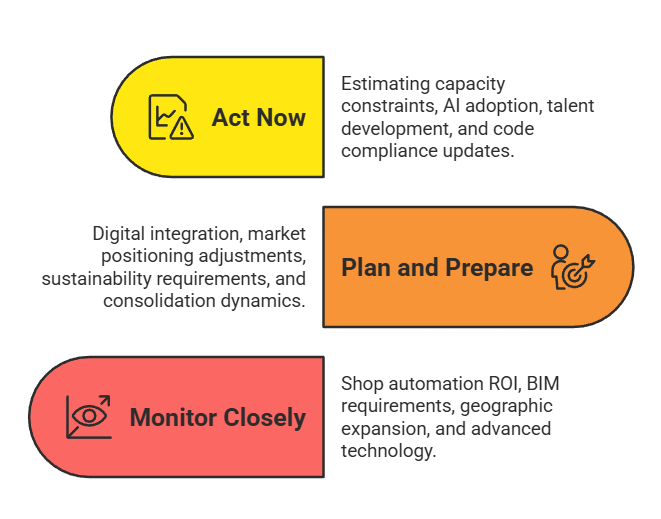
Which Trends Require Action versus Monitoring?
How Do You Stay Ahead?
Horizon 1: Defend Current Position (now to one year):
Invest in estimating capacity. Maintain service quality. Keep up with compliance. Deliver competitive pricing and responsiveness.
Horizon 2: Build New Capabilities (one to three years):
Technology adoption for competitive advantage. Talent development. Market positioning. Digital sophistication.
Horizon 3: Position for Future (three to five years):
Sustainability capabilities. Advanced automation and AI applications. New business models. Strategic options: growth, partnerships, or exit.
Recommended Allocation: 70% on Horizon 1, 20% on Horizon 2, 10% on Horizon 3.
Conclusion: Your Next Steps
The steel fabrication industry is splitting into three groups: leaders who proactively adopt technology, develop talent, and position strategically; followers who wait for proof before acting; and laggards who resist change.
For fabricators who read these signals correctly and act strategically, this is a significant opportunity to gain competitive advantage. Technology enhances existing barriers to entry for those who adopt wisely and integrate it with their strengths.
The cost of inaction compounds. Competitive advantages erode. Talent gaps become crises. Market positions weaken. The time to act is while you are strong and have options, not when crisis forces your hand.
This Week: Share this analysis with your leadership team. Discuss which trends affect you most. Identify your biggest vulnerability and opportunity.
This Month: Prioritize your top three strategic actions. Assess current capabilities versus required future capabilities. Plan investments, timeline, and resources.
This Quarter: Execute your highest-priority initiative. Establish baseline metrics. Schedule monthly check-ins on strategic progress.
This Year: Build capabilities that provide competitive advantage. Establish clear differentiation in your market. Prepare for the next wave of growth.
For deeper analysis on workflow improvements that can relieve capacity constraints, see Building a High-Performance Steel Estimating Workflow. To understand the full scope of the capacity crisis, read The Steel Estimating Crunch: Labor, Capacity, and Competitive Pressure Explained.
Book a demo and let us show you with your own blueprints exactly how SketchDeck works. During our demo, we will analyze one of your own project drawings and provide you with a free project in SketchDeck to see if it’s a good fit for your company: https://sketchdeck.ai/demo/